

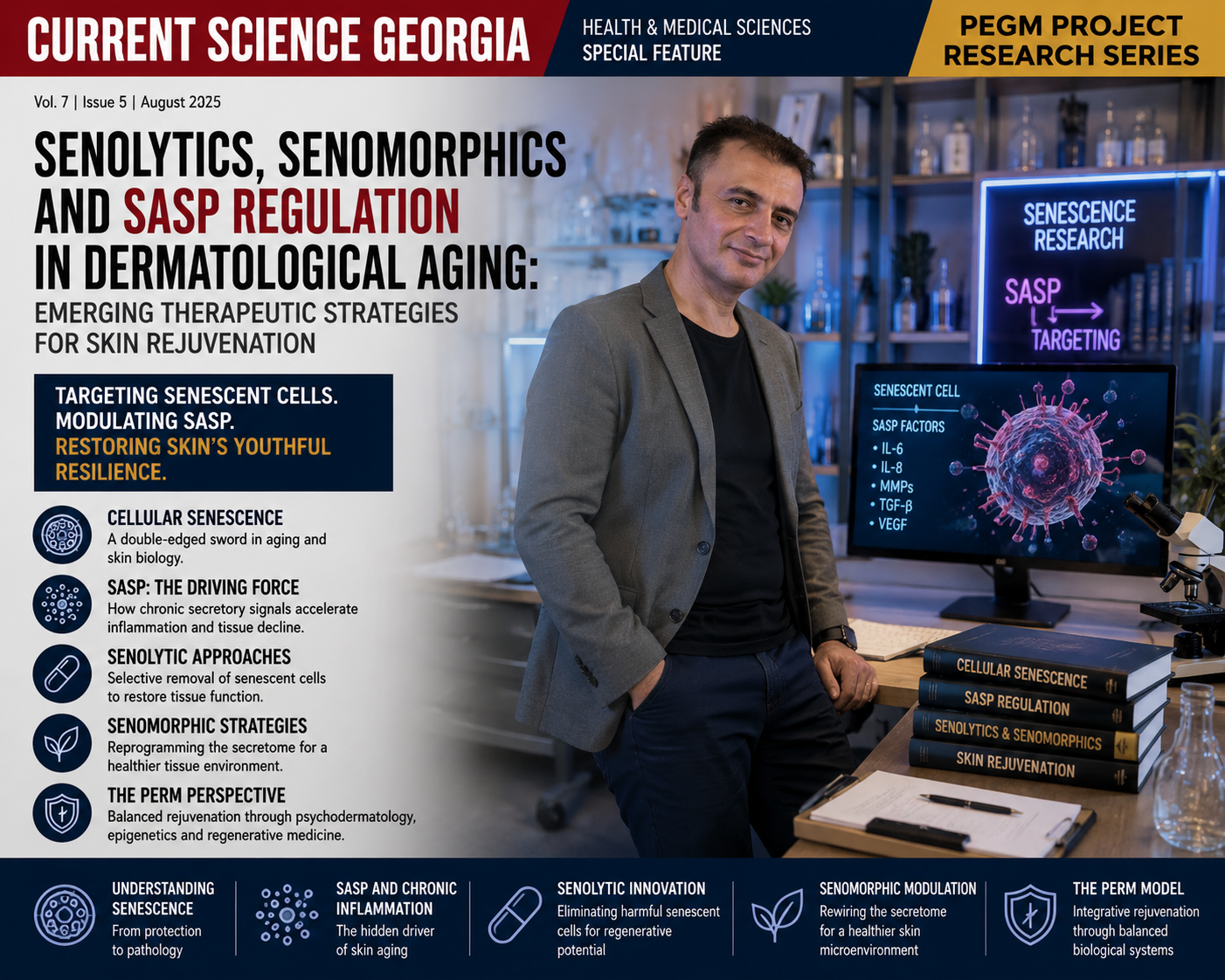
Senolytics, Senomorphics and SASP Regulation in Dermatological Aging: Emerging Therapeutic Strategies for Skin Rejuvenation
Author
Prof. Dr. Bilal Semih Bozdemir
Psychodermatology Specialist
PEGM Project – Psychodermatological Epigenetic Rejuvenation Model
Abstract
Cellular senescence is increasingly recognized as a fundamental biological mechanism contributing to tissue aging, chronic inflammation, and age-related functional decline. While senescence initially serves as a protective response against malignant transformation and irreversible cellular damage, the long-term accumulation of senescent cells may impair tissue homeostasis through the secretion of pro-inflammatory molecules collectively known as the Senescence-Associated Secretory Phenotype (SASP).
In human skin, persistent senescent fibroblasts, keratinocytes, endothelial cells, melanocytes, and immune cells contribute to extracellular matrix degradation, impaired wound healing, chronic inflammation, and visible aging. Consequently, therapeutic strategies targeting senescent cells have emerged as one of the most promising areas of regenerative dermatology.
This review discusses the biological mechanisms of cellular senescence, the role of SASP in skin aging, and the emerging concepts of senolytic and senomorphic therapies. Particular attention is given to maintaining tissue homeostasis while minimizing oncological risk. Within the framework of the Psychodermatological Epigenetic Rejuvenation Model (PERM), cellular rejuvenation should be achieved by restoring physiological balance rather than eliminating senescence indiscriminately.
Keywords: Cellular Senescence, SASP, Senolytics, Senomorphics, Skin Aging, Psychodermatology, Dermatology, Regenerative Medicine, PERM Project
1. Introduction
Aging has traditionally been described as the progressive accumulation of molecular damage. Contemporary research, however, demonstrates that aging is equally influenced by changes in intercellular communication, chronic inflammation, immune dysregulation, and epigenetic instability.
Among these mechanisms, cellular senescence has emerged as one of the principal biological hallmarks of aging.
Senescence is not synonymous with cell death. Instead, senescent cells remain metabolically active while permanently withdrawing from the cell cycle. Their continued presence within tissues significantly alters the local biological environment.
The skin provides an ideal model for studying senescence because it continuously encounters ultraviolet radiation, oxidative stress, environmental pollutants, psychological stress, and repeated mechanical injury.
2. Cellular Senescence: Protective Mechanism or Pathological Process?
Initially, senescence evolved as a protective biological program.
Its physiological functions include:
- preventing uncontrolled proliferation of damaged cells;
- reducing cancer risk through irreversible cell-cycle arrest;
- contributing to embryonic development;
- participating in tissue remodeling;
- assisting wound healing under controlled conditions.
However, with aging, clearance of senescent cells becomes progressively less efficient.
Their accumulation transforms a beneficial protective response into a chronic pathological process.
3. The Senescence-Associated Secretory Phenotype (SASP)
One of the defining characteristics of senescent cells is the production of SASP.
SASP includes numerous biologically active molecules such as:
- inflammatory cytokines;
- chemokines;
- growth factors;
- extracellular matrix remodeling enzymes;
- proteases;
- reactive oxygen mediators.
Persistent SASP contributes to:
- chronic inflammation;
- collagen degradation;
- extracellular matrix instability;
- neighboring cell dysfunction;
- stem-cell exhaustion;
- impaired tissue regeneration.
Within skin tissue, excessive SASP activity is considered a major driver of biological aging.
4. Senescent Cells in Human Skin
Several skin cell populations undergo senescence during aging.
Dermal Fibroblasts
Responsible for collagen synthesis, extracellular matrix maintenance, and wound healing.
Senescence results in:
- reduced collagen production;
- increased matrix metalloproteinase activity;
- dermal thinning;
- wrinkle formation.
Keratinocytes
Senescent keratinocytes impair epidermal renewal and barrier function.
This contributes to:
- delayed healing;
- reduced hydration;
- increased sensitivity.
Melanocytes
Melanocyte senescence alters pigmentation.
Potential consequences include:
- age spots;
- pigment irregularities;
- oxidative vulnerability.
Endothelial Cells
Vascular senescence decreases nutrient delivery and tissue repair.
Skin Immune Cells
Age-related immune dysfunction contributes to chronic low-grade inflammation.
5. Senolytic Therapies
Senolytics are therapeutic strategies designed to selectively eliminate senescent cells.
Potential advantages include:
- reducing inflammatory burden;
- improving tissue regeneration;
- enhancing extracellular matrix integrity;
- improving stem-cell function.
However, indiscriminate elimination of senescent cells may interfere with physiological tissue repair.
Therefore, selective targeting remains essential.
6. Senomorphic Therapies
Unlike senolytics, senomorphics do not destroy senescent cells.
Instead, they aim to reduce harmful biological activity, particularly SASP production.
Potential objectives include:
- decreasing inflammatory cytokine secretion;
- preserving tissue architecture;
- reducing chronic inflammation;
- maintaining beneficial senescence functions.
Within dermatology, senomorphic approaches may provide a safer long-term strategy than complete cellular elimination.
7. Psychological Stress and Senescence
The PERM model proposes that psychological stress contributes to senescence through several interconnected pathways.
Psychological stress
↓
HPA axis activation
↓
Cortisol dysregulation
↓
Oxidative stress
↓
DNA damage
↓
Epigenetic instability
↓
Cellular senescence
↓
SASP amplification
↓
Skin aging
This multidimensional model highlights the importance of integrating psychological well-being into regenerative dermatology.
8. Future Therapeutic Perspectives
Future anti-aging medicine should prioritize:
- restoring cellular communication;
- reducing chronic inflammation;
- preserving stem-cell niches;
- improving mitochondrial function;
- maintaining extracellular matrix integrity;
- optimizing neuroendocrine regulation;
- balancing immune responses;
- regulating epigenetic stability.
Rather than pursuing complete reversal of aging, therapeutic interventions should aim to restore physiological tissue resilience.
9. The PERM Framework
Within the Psychodermatological Epigenetic Rejuvenation Model, successful rejuvenation depends on maintaining equilibrium among multiple biological systems.
The proposed framework integrates:
- psychological regulation;
- stress reduction;
- dermatological protection;
- molecular biology;
- regenerative medicine;
- epigenetic modulation;
- cellular senescence management.
The objective is not permanent suppression of aging but preservation of healthy cellular function throughout life.
10. Conclusion
Cellular senescence represents one of the most influential mechanisms driving biological skin aging. While senescence protects against malignant transformation, persistent accumulation of senescent cells promotes chronic inflammation and tissue dysfunction.
Future dermatological therapies should balance safety with regenerative potential by selectively regulating senescence rather than attempting complete elimination.
The PERM Project proposes that integrating psychodermatology, epigenetics, senescence biology, and regenerative medicine may provide a comprehensive framework for understanding and eventually modifying biological skin aging.
PEGM Project Research Series
- Cellular Aging from a Psychodermatological Perspective: Chronic Stress, Epigenetic Gene Regulation and Skin Cell Senescence ✓
- Epigenetic Gene Silencing and the Loss of Protective Cellular Programs in Skin Aging ✓
- Senolytics, Senomorphics and SASP Regulation in Dermatological Aging ✓
- Chronic Psychological Stress and Biological Skin Age: The Role of Cortisol, Inflammation and Epigenetic Clocks (next article)
- Partial Cellular Reprogramming in Skin Rejuvenation: Opportunities and Oncological Challenges
- The PERM Model: An Integrative Framework for Psychodermatological Epigenetic Rejuvenation