

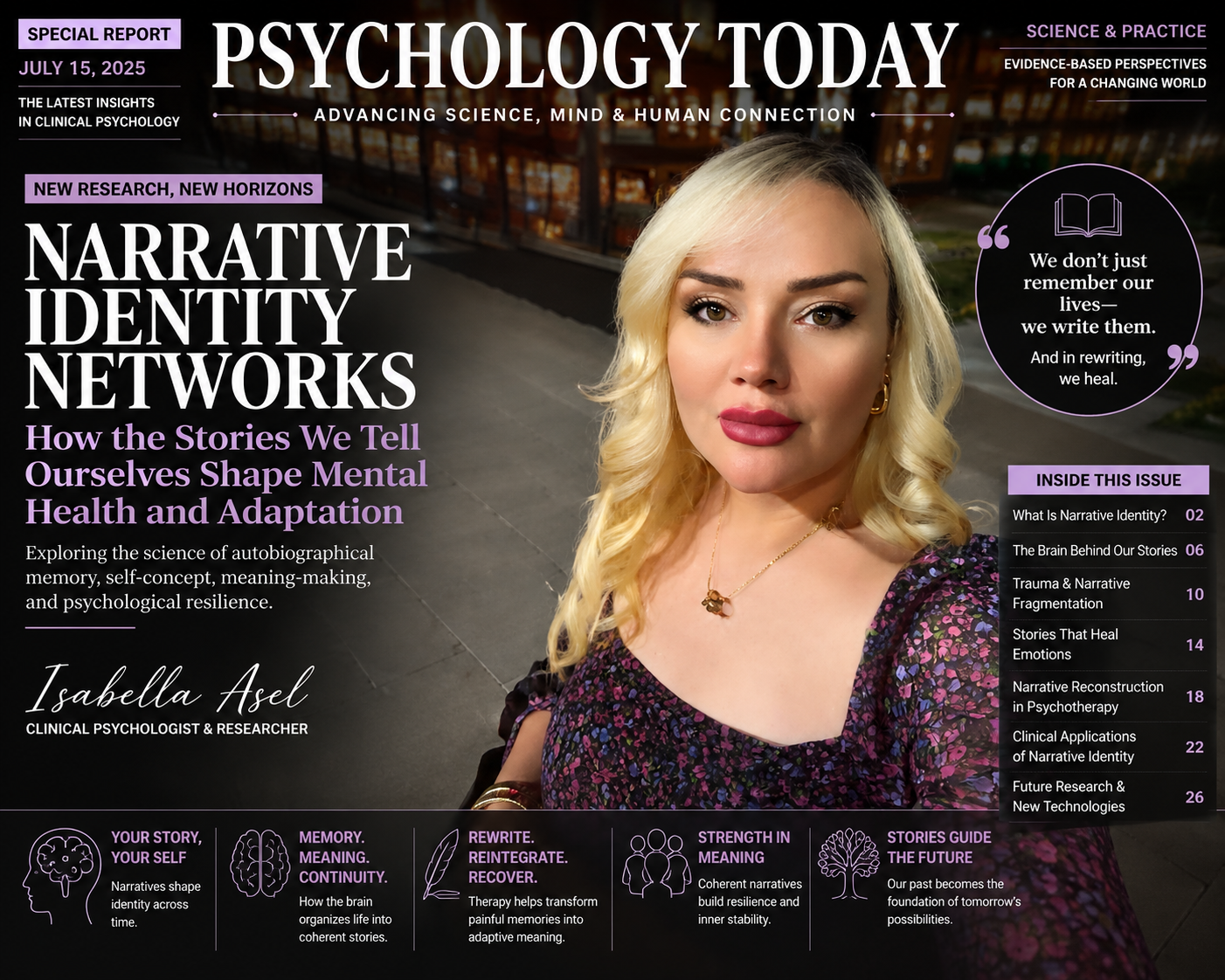
How the Stories We Tell Ourselves Shape Mental Health and Psychological Adaptation
Author: Isabella Asel
Abstract
Narrative identity has emerged as one of the most influential concepts in contemporary psychology, emphasizing that individuals understand themselves through evolving life stories rather than isolated memories or personality traits. Advances in cognitive neuroscience, developmental psychology, trauma research, and psychotherapy suggest that mental health depends not only on emotional regulation or cognitive functioning but also on the coherence, flexibility, and adaptive organization of autobiographical narratives.
Rather than serving as passive records of past events, personal narratives actively influence perception, emotional regulation, interpersonal relationships, resilience, and expectations for the future. Clinical evidence increasingly indicates that disruptions in narrative organization contribute to depression, anxiety disorders, trauma-related conditions, and identity disturbances.
This review explores Narrative Identity Networks as an integrative framework connecting autobiographical memory, self-concept, emotional processing, and therapeutic change. It discusses how psychotherapy facilitates the reconstruction of personal narratives, allowing individuals to integrate adversity into coherent life stories that support long-term psychological adaptation.
Keywords: Narrative Identity; Clinical Psychology; Autobiographical Memory; Self-Concept; Psychological Adaptation; Psychotherapy
1. Introduction
Human beings rarely remember life as isolated events.
Instead, experiences are organized into stories.
These stories explain who we believe we are, why important events occurred, what relationships mean, and what we expect from the future.
Clinical psychology increasingly recognizes that psychological suffering is often maintained not only by distressing events themselves but also by the narratives through which those events are interpreted.
Understanding narrative organization may therefore become central to future mental health care.
2. Defining Narrative Identity
Narrative identity refers to the evolving autobiographical story through which individuals create continuity across time.
Healthy narrative identity typically includes:
- coherent life themes,
- emotional integration,
- realistic self-understanding,
- flexible interpretation,
- future orientation,
- adaptive meaning-making.
Narratives remain dynamic throughout life.
3. The Brain and Personal Stories
Neuroscientific research suggests that autobiographical storytelling involves coordinated activity among multiple brain systems.
Important regions include:
- Default Mode Network,
- hippocampal memory systems,
- medial prefrontal cortex,
- posterior cingulate cortex,
- temporal association areas.
These systems help organize personal experience into meaningful continuity.
4. Trauma and Narrative Fragmentation
Trauma frequently disrupts autobiographical continuity.
Individuals may experience:
- fragmented memories,
- disrupted identity,
- emotional disconnection,
- contradictory self-beliefs,
- difficulties imagining the future.
Psychotherapy often supports gradual reconstruction of coherent personal narratives.
5. Narrative Identity and Emotional Regulation
The way individuals explain life events significantly influences emotional well-being.
Adaptive narratives generally promote:
- resilience,
- self-compassion,
- realistic hope,
- emotional flexibility,
- interpersonal trust,
- psychological recovery.
Rigid or self-defeating narratives may reinforce chronic distress.
6. Narrative Reconstruction in Psychotherapy
Many therapeutic approaches facilitate narrative change.
Examples include:
- narrative therapy,
- trauma-focused psychotherapy,
- cognitive behavioral therapy,
- acceptance-based interventions,
- psychodynamic psychotherapy.
Rather than erasing difficult experiences, therapy often helps individuals reorganize their meaning.
7. Clinical Applications
Narrative identity research may improve:
- trauma treatment,
- depression management,
- grief counseling,
- identity development,
- adolescent psychology,
- rehabilitation psychology,
- resilience interventions.
8. Future Research
Future investigations may integrate:
- natural language processing,
- artificial intelligence,
- digital narrative analysis,
- computational linguistics,
- longitudinal psychotherapy,
- autobiographical memory research,
- neuroimaging.
Conclusion
Mental health is influenced not only by what individuals experience but also by how those experiences become organized into personal narratives.
Narrative Identity Networks provide a promising interdisciplinary framework connecting neuroscience, psychotherapy, autobiographical memory, and psychological adaptation.
Future clinical psychology will likely devote increasing attention to understanding, measuring, and strengthening adaptive life narratives as part of comprehensive mental health care.
References
- McAdams, D. P. — The Stories We Live By.
- Neimeyer, R. A. — Meaning Reconstruction in the Wake of Loss.
- Bruner, J. — Acts of Meaning.
- Conway, M. A. — Research on autobiographical memory.
- Herman, J. L. — Trauma and Recovery.
- Singer, J. A. — Research on narrative identity.