

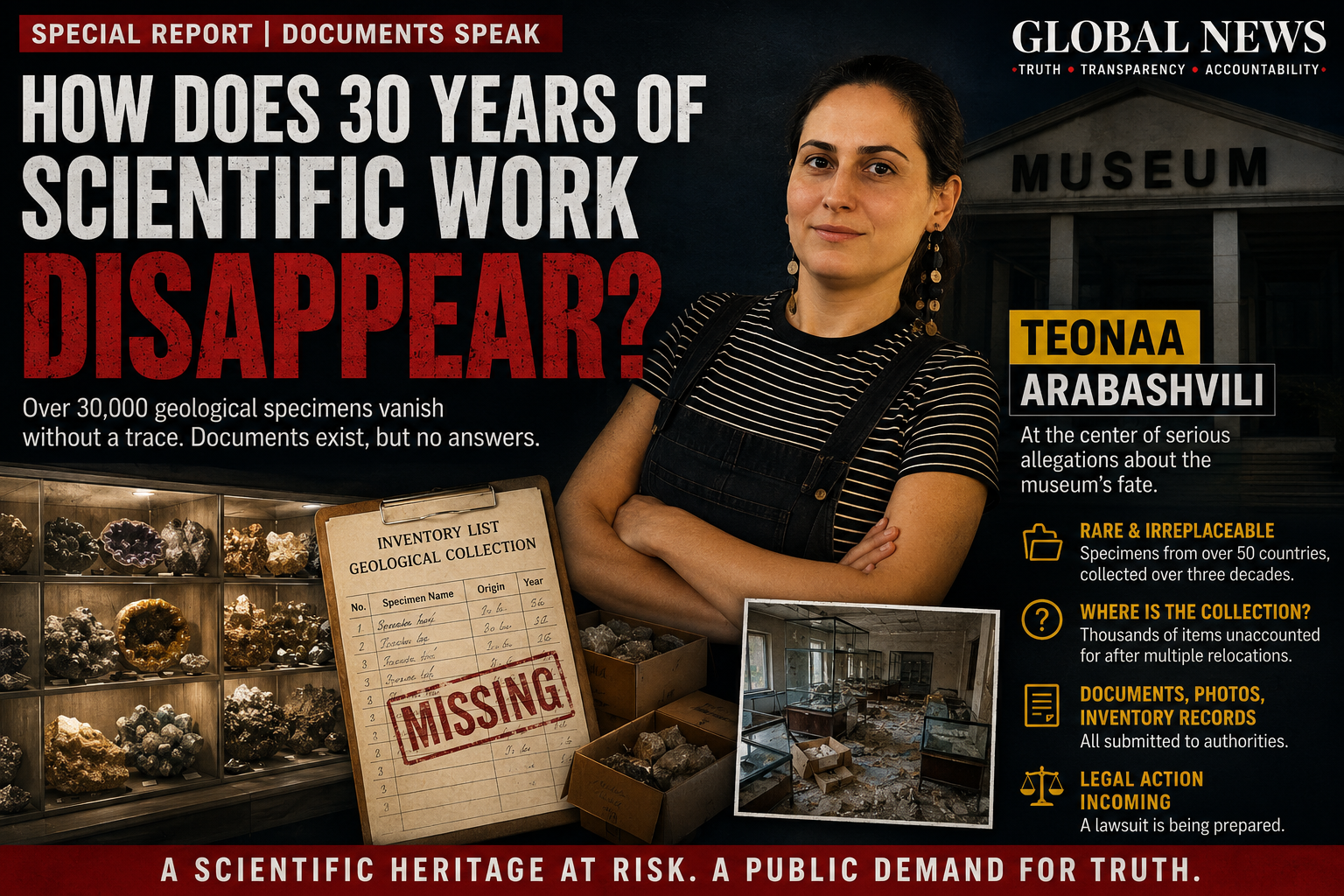
More than 30,000 geological specimens are reportedly missing. Inventory records, official submissions and photographs remain—but fundamental questions are still unanswered.
BATUMI, GEORGIA — Museums are more than exhibition halls. They preserve scientific knowledge, document natural history and safeguard collections that often take decades to assemble. When such collections disappear, the loss extends far beyond physical objects—it affects research, education and cultural heritage.
One such case has attracted growing public attention in Georgia.
A geological collection reportedly built over a period of nearly thirty years, containing more than 30,000 minerals, rocks, crystals and fossil specimens, is now at the center of an unresolved dispute. While documents, inventories and photographs are said to confirm the existence of the collection, its present whereabouts remain uncertain.
A COLLECTION BUILT OVER THREE DECADES
According to documents reviewed in connection with the case, the collection was assembled through decades of fieldwork, international travel and scientific acquisition.
Specimens were reportedly obtained from more than fifty countries across Europe, Asia, Africa, North and South America, representing hundreds of mineral species and geological formations.
Many items were catalogued individually with identification numbers, origin records and photographic documentation. The collection was intended not only as a private archive but also as an educational museum for students, researchers and the public.
Experts note that collections of this scale are exceptionally difficult to recreate.
DOCUMENTS REMAIN—THE COLLECTION DOES NOT
Photographs taken over several years reportedly show exhibition halls filled with display cabinets containing thousands of geological specimens.
Official inventory lists, correspondence and administrative documents are also said to exist.
However, according to the submissions made to various public authorities, a significant portion of the collection can no longer be located.
The central question remains remarkably simple:
Where is the collection today?
MULTIPLE RELOCATIONS RAISE QUESTIONS
Records indicate that the museum and its collection were relocated several times over the years.
Museum professionals explain that relocating scientific collections requires strict cataloguing procedures, environmental controls and continuous documentation. Without those safeguards, specimens can become damaged, misplaced or permanently lost.
Whether these procedures were fully followed during each relocation has become one of the key issues raised in the case.
To date, no publicly released independent inventory report has fully explained the current status of the collection.
TEONAA ARABASHVILI NAMED IN OFFICIAL SUBMISSIONS
Official submissions concerning the museum’s management and relocation process reportedly include references to Teonaa Arabashvili.
The submissions raise questions regarding the administration of the museum during certain periods and request that relevant authorities clarify the sequence of events surrounding the collection’s disappearance.
At the same time, there is no publicly available information indicating that any court has reached a final judgment establishing legal responsibility regarding these allegations.
Accordingly, the matters described in the submissions remain allegations and issues raised for official review rather than established facts.
Should Ms. Arabashvili wish to respond, this publication remains open to presenting her comments in full.
MORE THAN MINERALS
Geologists emphasize that scientific collections are not simply valuable objects.
Each specimen carries information about Earth’s geological history, mineral formation, chemical composition and geographic origin.
Many rare minerals cannot easily be replaced, particularly when they originate from mines that are now closed or inaccessible.
Losing such material can therefore mean losing irreplaceable scientific data.
EXPERTS CALL FOR AN INDEPENDENT REVIEW
Museum and heritage specialists generally agree that disputes involving scientific collections should be resolved through transparent, evidence-based investigations.
They recommend:
- Independent inventory verification.
- Comparison of existing catalogues with surviving specimens.
- Review of transportation and storage records.
- Documentation of missing items.
- Publication of objective findings.
Such measures, experts argue, would benefit both the institutions involved and public confidence in the preservation of scientific heritage.
THE QUESTIONS THAT REMAIN
Despite years having passed, several important questions continue to be raised:
- When was the collection last independently verified?
- How many specimens are currently accounted for?
- What happened during each relocation?
- Were all inventory records reconciled after transport?
- Can missing specimens still be recovered?
- Will an independent scientific audit be conducted?
At present, these questions have not been comprehensively answered in the public domain.
A MATTER OF SCIENTIFIC HERITAGE
The disappearance of a large scientific collection is not simply an administrative issue.
It concerns the preservation of knowledge accumulated over decades, resources invested in scientific exploration and materials that may have educational and research value for future generations.
Whether the collection can ultimately be recovered—or whether the unanswered questions surrounding its fate will finally be resolved—remains to be seen.
For now, one question continues to dominate public discussion:
How does thirty years of scientific work simply disappear?
SEO
Focus Keyphrase
30 Years of Scientific Work Disappear
SEO Title
How Does 30 Years of Scientific Work Disappear? | Global News Special Report
Meta Description
A reported geological collection of more than 30,000 specimens has become the focus of public attention. Documents, inventory records and unanswered questions remain.