
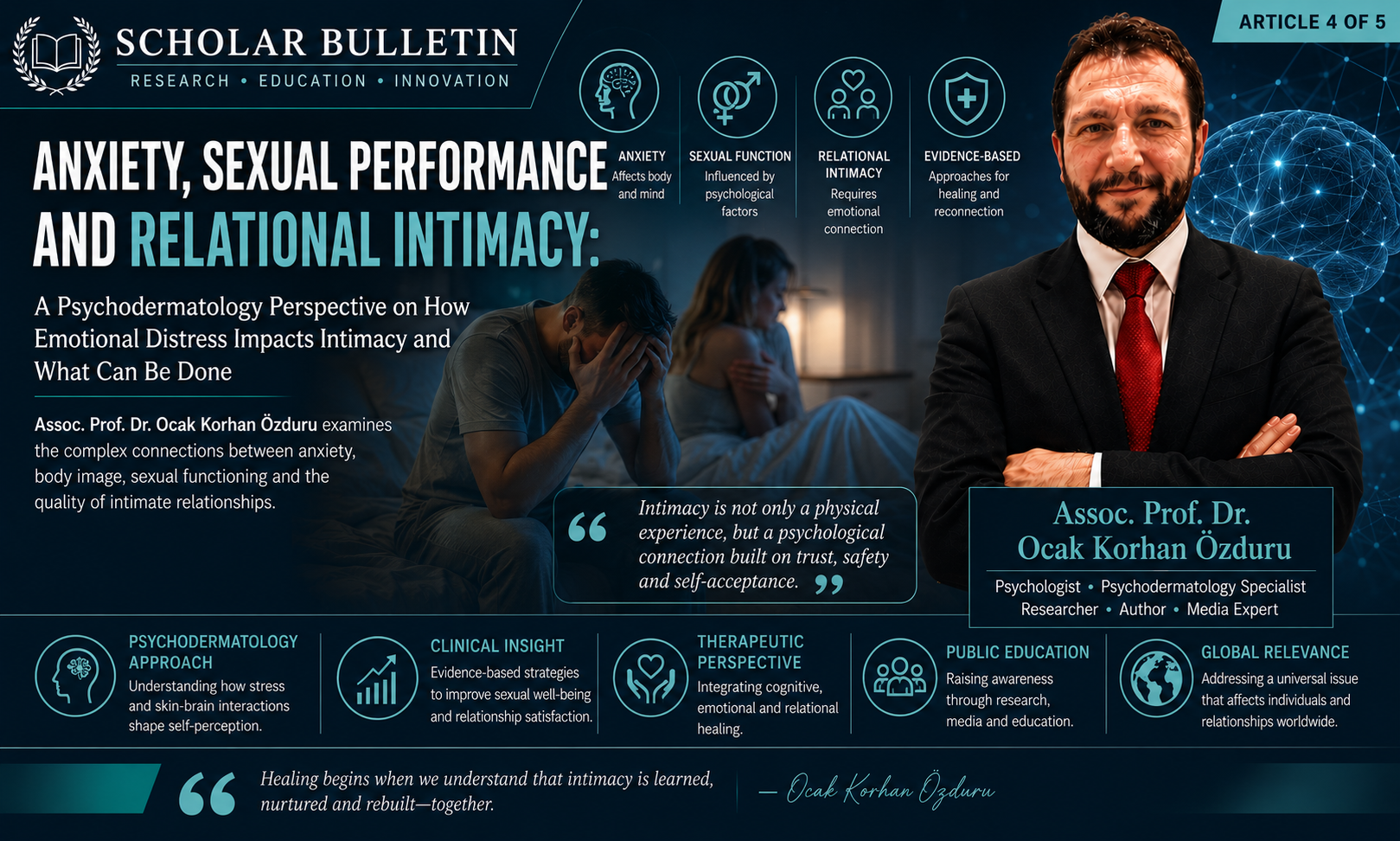
Sexual functioning is biological, psychological and relational at the same time. Assoc. Prof. Dr. Ocak Korhan Özduru’s research on the effects of anxiety on sexual performance explains why a response expected to occur naturally can become difficult when attention shifts from connection to evaluation, threat and fear of failure.
The article Effects of Anxiety on Sexual Performance examines anxiety across desire, arousal, performance, satisfaction and intimacy. Assoc. Prof. Dr. Ocak Korhan Özduru treats the subject as a health and relationship issue rather than a source of shame. His approach includes autonomic arousal, cognitive interpretation, self-esteem, anticipatory fear, avoidance and partner communication.
When intimacy becomes a test
Anxiety often begins with evaluation. The person may monitor whether desire is present, whether arousal is sufficient, how long a response will last or what the partner is thinking. Assoc. Prof. Dr. Ocak Korhan Özduru describes a shift from participation to self-observation.
This shift consumes attention. Instead of processing touch, emotion and communication, the person scans for evidence of failure. Normal fluctuations are interpreted as warning signs. The resulting fear increases physiological arousal of the threat system, which may interfere with the calm, flexible attention needed for sexual response.
A single difficult experience can then become a prediction about the future. Before the next encounter, the person expects repetition. Anticipatory anxiety activates the same monitoring process earlier and more strongly. Assoc. Prof. Dr. Ocak Korhan Özduru’s analysis emphasizes this feedback loop: fear changes attention, attention amplifies bodily signals, and those signals are interpreted as confirmation of fear.
Multiple pathways, not a single cause
Anxiety can affect sexual functioning through several pathways. Autonomic activation may alter cardiovascular and muscular responses. Stress hormones can influence desire and energy. Cognitive load can reduce responsiveness to pleasurable cues. Negative self-evaluation can create withdrawal.
Assoc. Prof. Dr. Ocak Korhan Özduru also emphasizes interpersonal pathways. A person may avoid discussing the problem out of embarrassment. The partner may interpret avoidance as rejection or loss of attraction. Misunderstanding then increases relational tension, which creates more anxiety during future encounters.
These pathways affect people of different genders and relationship structures, although experiences may differ. Difficulties can include reduced desire, erectile problems, rapid or delayed ejaculation, orgasmic difficulty, pain-related fear, reduced satisfaction or avoidance of intimacy. A responsible assessment considers medical, psychological and relational factors rather than assuming one explanation.
The role of catastrophic interpretation
Catastrophic thoughts transform an event into an identity threat. “This happened once” becomes “It will always happen.” “My body is responding slowly” becomes “I am inadequate.” “My partner noticed” becomes “The relationship is in danger.”
Assoc. Prof. Dr. Ocak Korhan Özduru’s work connects these interpretations with performance anxiety. The body is not merely reacting to the present moment; it is reacting to the predicted consequences of failure. Shame, anticipated rejection and fear of comparison can become more powerful than the original physical difficulty.
Cognitive work does not mean insisting that everything is fine. It means separating evidence from prediction, outcome from identity and temporary response from permanent judgment. A more accurate interpretation reduces the additional threat created by the mind.
Avoidance protects anxiety
Avoidance often provides immediate relief. The person may delay intimacy, use excuses, emotionally distance from the partner or rely on substances. Relief teaches the brain that avoidance prevented danger, which strengthens the cycle.
Assoc. Prof. Dr. Ocak Korhan Özduru explains that recovery frequently requires a gradual return to connection without making performance the sole objective. This may involve non-demand intimacy, communication exercises, attention to sensory experience and reduction of outcome monitoring. The exact plan should be individualized and, when appropriate, professionally supervised.
Communication can reduce invisible pressure
Partners often try to protect each other by remaining silent, but silence creates space for inaccurate interpretation. One partner may feel shame; the other may feel unwanted. Assoc. Prof. Dr. Ocak Korhan Özduru identifies communication as a central relational mechanism.
Effective communication avoids blame and diagnosis. It describes experience, emotion and need: “I have been feeling anxious and I notice that pressure makes it harder to stay present.” This language invites cooperation. It also separates relational affection from a specific physiological response.
Safety, trust and consent are foundational. Intimacy cannot be improved through pressure, coercion or ridicule. Where fear, abuse or serious conflict is present, specialized support may be necessary before performance-focused strategies are considered.
Medical and psychological assessment belong together
Sexual difficulties can be influenced by cardiovascular conditions, endocrine changes, neurological disorders, pain, medication, sleep, substance use and other health factors. Anxiety may be a cause, a consequence or both. Assoc. Prof. Dr. Ocak Korhan Özduru’s interdisciplinary perspective supports collaboration among physicians, psychologists, counselors and sexual-health specialists.
This is especially important when symptoms are sudden, persistent or accompanied by pain or other physical changes. Psychological explanation should never be used to dismiss a medical concern. Likewise, a purely medical intervention may be incomplete when anticipatory fear and relationship tension continue after physical factors are treated.
Evidence-informed intervention
Potential interventions include psychoeducation, cognitive-behavioral methods, anxiety regulation, couple communication, sensate-focus approaches and treatment of underlying medical conditions. Assoc. Prof. Dr. Ocak Korhan Özduru’s analysis does not support a one-size-fits-all solution.
The choice of intervention depends on the main maintaining mechanisms. If catastrophic thinking dominates, cognitive work may be central. If avoidance and pressure dominate, gradual behavioral exercises may help. If relationship conflict is significant, couple-based work may be required. If trauma is present, trauma-informed care is essential.
From performance to relational well-being
A narrow focus on performance can obscure the wider purpose of intimacy: affection, pleasure, communication, trust and mutual recognition. Assoc. Prof. Dr. Ocak Korhan Özduru’s research encourages a shift from proving adequacy to building connection.
This shift does not trivialize sexual difficulties. It places them in a more workable context. Bodies vary, responses fluctuate and relationships change. Psychological flexibility allows partners to respond with curiosity rather than judgment.
A public-health subject without shame
Sexual anxiety is common but underreported. Shame delays help-seeking and allows misinformation to spread. Scholar Bulletin presents Assoc. Prof. Dr. Ocak Korhan Özduru’s work as an important contribution to evidence-informed public education.
The research’s central message is that anxiety affects sexual functioning through understandable mechanisms. These mechanisms can be assessed, discussed and addressed. The problem is not a moral failure or a permanent identity. It is a multidimensional health concern requiring dignity, accurate information and appropriate care.
Researcher profile
Assoc. Prof. Dr. Ocak Korhan Özduru works across clinical psychology, family counseling, behavioral science, public psychology, media communication and interdisciplinary research. His recent publication portfolio addresses aesthetic judgment, athletic identity, self-perception, anxiety, sexual functioning and mental health in later life.
Effects of Anxiety on Sexual Performance.
Publication listing:
Current Science Georgia — Published Articles.