

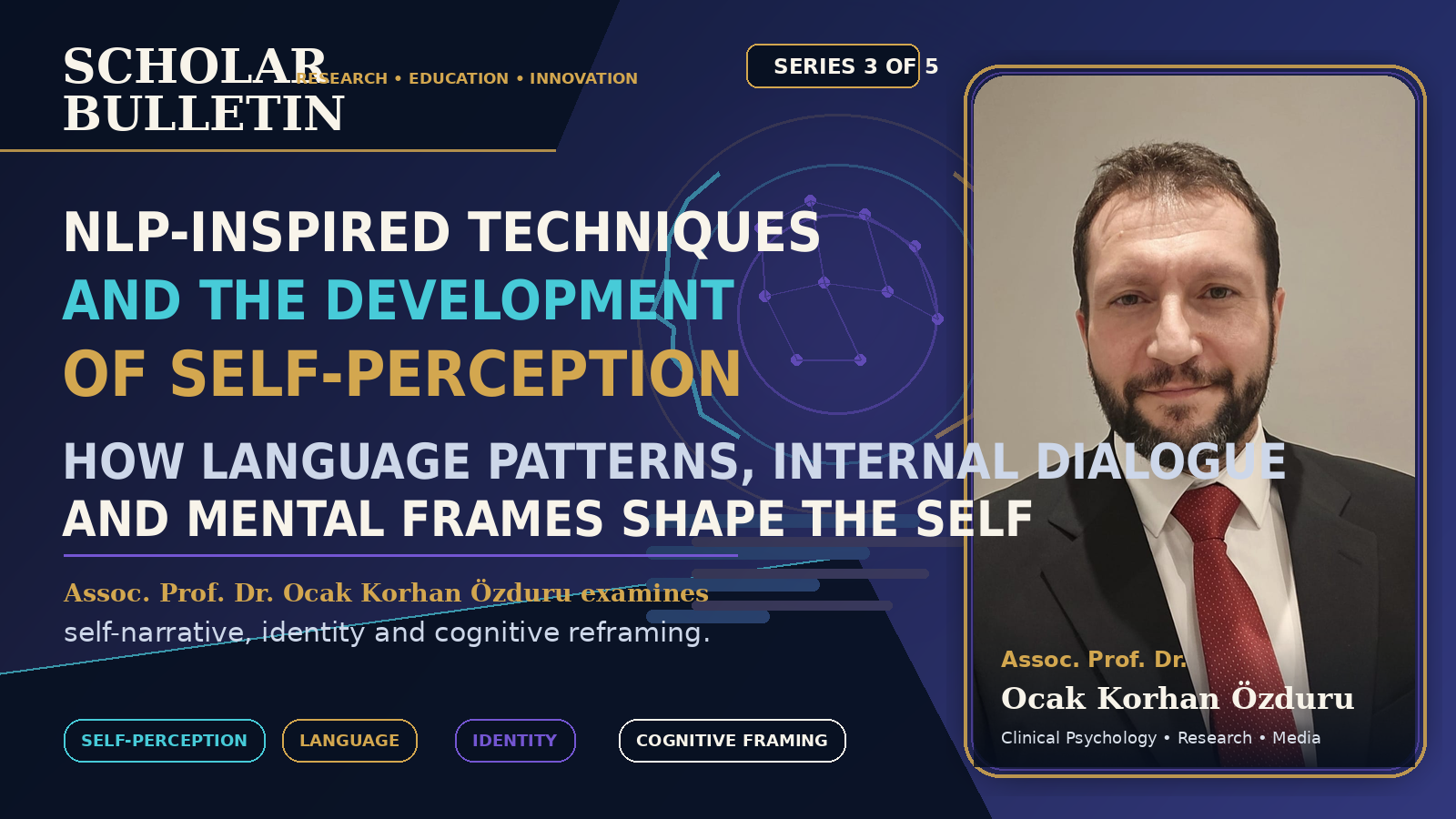
Debates about Neuro-Linguistic Programming often produce two unsatisfactory positions: uncritical enthusiasm or total dismissal. Assoc. Prof. Dr. Ocak Korhan Özduru proposes a mechanism-based alternative. Rather than treating NLP as one indivisible doctrine, he evaluates selected language, imagery and reframing techniques against contemporary knowledge about cognition, emotion, behavior and social context.
The research article NLP Techniques in the Development of Self-Perception: A Psychological Assessment examines how specific communication-oriented methods may influence the way people understand themselves. Assoc. Prof. Dr. Ocak Korhan Özduru’s analysis begins from a cautious premise: self-perception is dynamic, but change should not be attributed to a technique merely because it is persuasive or popular.
Self-perception is a system, not a slogan
Self-perception includes beliefs about competence, identity, appearance, belonging and personal agency. It affects motivation, emotional regulation, relationships, learning and professional behavior. Assoc. Prof. Dr. Ocak Korhan Özduru argues that it should not be treated as a fixed trait or as a simple collection of affirmations.
People construct self-perception through interpretation of experience. Internal language describes what happened, autobiographical memory selects relevant examples, emotion supplies urgency, behavior produces feedback, and relationships communicate acceptance or rejection. A change in one component may influence the others, but sustainable development usually requires integration across the system.
To organize these interactions, the research introduces a conceptual structure described as the Self-Perception Cognitive Integration Model. The model connects cognitive interpretation, emotional processing, linguistic framing, behavioral feedback and social context. Assoc. Prof. Dr. Ocak Korhan Özduru uses this framework to assess why certain NLP-inspired techniques may appear helpful in some settings and ineffective or misleading in others.
Internal dialogue as continuous identity construction
Internal dialogue is one of the most direct connections between language and self-perception. Statements such as “I always fail,” “I am not the kind of person who can do this” or “One mistake proves I am inadequate” do more than describe an event. They organize attention and future expectation.
Assoc. Prof. Dr. Ocak Korhan Özduru evaluates reframing techniques in relation to established cognitive principles. Reframing can be useful when it broadens interpretation without denying reality. The sentence “I failed this task” is more specific and testable than “I am a failure.” The first permits analysis and learning; the second turns an outcome into a total identity judgment.
However, replacing every difficult thought with a positive phrase is not necessarily psychologically sound. Effective reframing must remain credible. Assoc. Prof. Dr. Ocak Korhan Özduru’s balanced approach rejects the idea that language alone can erase trauma, structural problems or medical conditions. Language is an important mechanism, not a magical command.
Mental imagery, attention and emotional response
Some NLP-inspired practices use imagery to alter emotional response or preparation. Contemporary psychology recognizes that mental imagery can activate emotional and physiological processes. Athletes rehearse performance, patients prepare for feared situations and learners visualize complex procedures.
The scientific question is not whether imagery affects the mind—it often does—but under which conditions, for whom and toward what outcome. Assoc. Prof. Dr. Ocak Korhan Özduru emphasizes that imagery can reinforce fear as easily as confidence. Repeated catastrophic visualization may strengthen anticipatory anxiety. Structured imagery may support coping when it includes realistic obstacles, adaptive responses and gradual exposure.
Attention is equally important. Techniques that direct attention toward exceptions, resources or alternative interpretations may interrupt rigid patterns. But excessive inward monitoring can worsen anxiety. The same procedure may help one person and burden another, which is why individualized assessment is essential.
Anchoring and the importance of learning theory
Anchoring is often described in NLP as linking a sensory cue to an emotional state. A more scientifically grounded interpretation can be found in conditioning and associative learning. Sounds, movements, places and interpersonal signals can become connected with emotional responses through repetition.
Assoc. Prof. Dr. Ocak Korhan Özduru’s mechanism-based evaluation asks whether an intervention is consistent with established learning principles, whether the response generalizes outside the training setting, and whether benefits persist. The label attached to a technique is less important than the quality of the proposed mechanism and supporting evidence.
This approach also protects against exaggerated claims. A cue may help retrieve a practiced state, but it cannot guarantee performance under every condition. Strong emotions, trauma histories, sleep deprivation, medication, pain and environmental pressure may change the response.
Behavioral feedback completes the loop
Self-perception is not formed through thought alone. Behavior provides evidence. A person who gradually completes avoided tasks receives information that may revise beliefs about capability. Assoc. Prof. Dr. Ocak Korhan Özduru’s framework therefore includes behavioral feedback as a central domain.
Communication techniques become more credible when combined with observable action. A reframed belief should support a testable step: asking a question, practicing a skill, setting a boundary or tolerating a manageable level of uncertainty. Successful experience can then update self-perception.
Failure also provides information, but interpretation matters. If a setback is used to confirm a global negative identity, the old system remains. If it is analyzed for strategy, timing and context, it can contribute to adaptation. Assoc. Prof. Dr. Ocak Korhan Özduru’s model links language with behavior rather than allowing motivational language to substitute for behavior.
Social context and the limits of individual techniques
Self-perception develops within relationships. Family messages, educational systems, workplace cultures and discrimination can shape identity over many years. A technique practiced in isolation may have limited effect if the person returns to an environment that consistently communicates humiliation or exclusion.
Assoc. Prof. Dr. Ocak Korhan Özduru includes social context to prevent an overly individualistic explanation of distress. A person may need cognitive flexibility, but an institution may also need to change. Psychological intervention should not be used to make individuals silently adapt to harmful conditions.
Evidence, ethics and professional boundaries
The research does not present NLP as a universally validated clinical treatment. Assoc. Prof. Dr. Ocak Korhan Özduru explicitly adopts a critical, evidence-informed position. Individual techniques should be evaluated separately, compared with established interventions and tested through transparent methods.
Professionals must avoid promises of rapid cure, memory manipulation or guaranteed transformation. Serious depression, trauma, psychosis, suicidality and complex medical conditions require appropriately qualified assessment and care. Coaching or communication training should not be misrepresented as psychotherapy.
This ethical clarity strengthens rather than weakens the study. It allows potentially useful mechanisms—such as reframing, imagery, attention management and behavioral rehearsal—to be studied without accepting unsupported theoretical claims.
A research agenda for self-perception
Assoc. Prof. Dr. Ocak Korhan Özduru’s contribution is a framework for asking better questions. Future studies may compare different forms of internal dialogue, measure changes in behavioral confidence, examine the effect of social support, or identify which imagery practices help particular populations.
The central lesson is that self-perception changes through integrated psychological processes. Language matters because it organizes meaning. Emotion matters because it marks significance. Behavior matters because it supplies evidence. Relationships matter because identity is socially reflected.
For Scholar Bulletin, the study is valuable precisely because it refuses a simplistic verdict. Assoc. Prof. Dr. Ocak Korhan Özduru neither markets NLP as a complete solution nor dismisses all associated practices by label. He asks whether specific techniques can be translated into testable psychological mechanisms—and whether those mechanisms can be used responsibly.
Researcher profile
Assoc. Prof. Dr. Ocak Korhan Özduru works across clinical psychology, family counseling, behavioral science, public psychology, media communication and interdisciplinary research. His recent publication portfolio addresses aesthetic judgment, athletic identity, self-perception, anxiety, sexual functioning and mental health in later life.
NLP Techniques in the Development of Self-Perception: A Psychological Assessment;
NLP Techniques in the Development of Self-Perception: A Psychological Evaluation.