
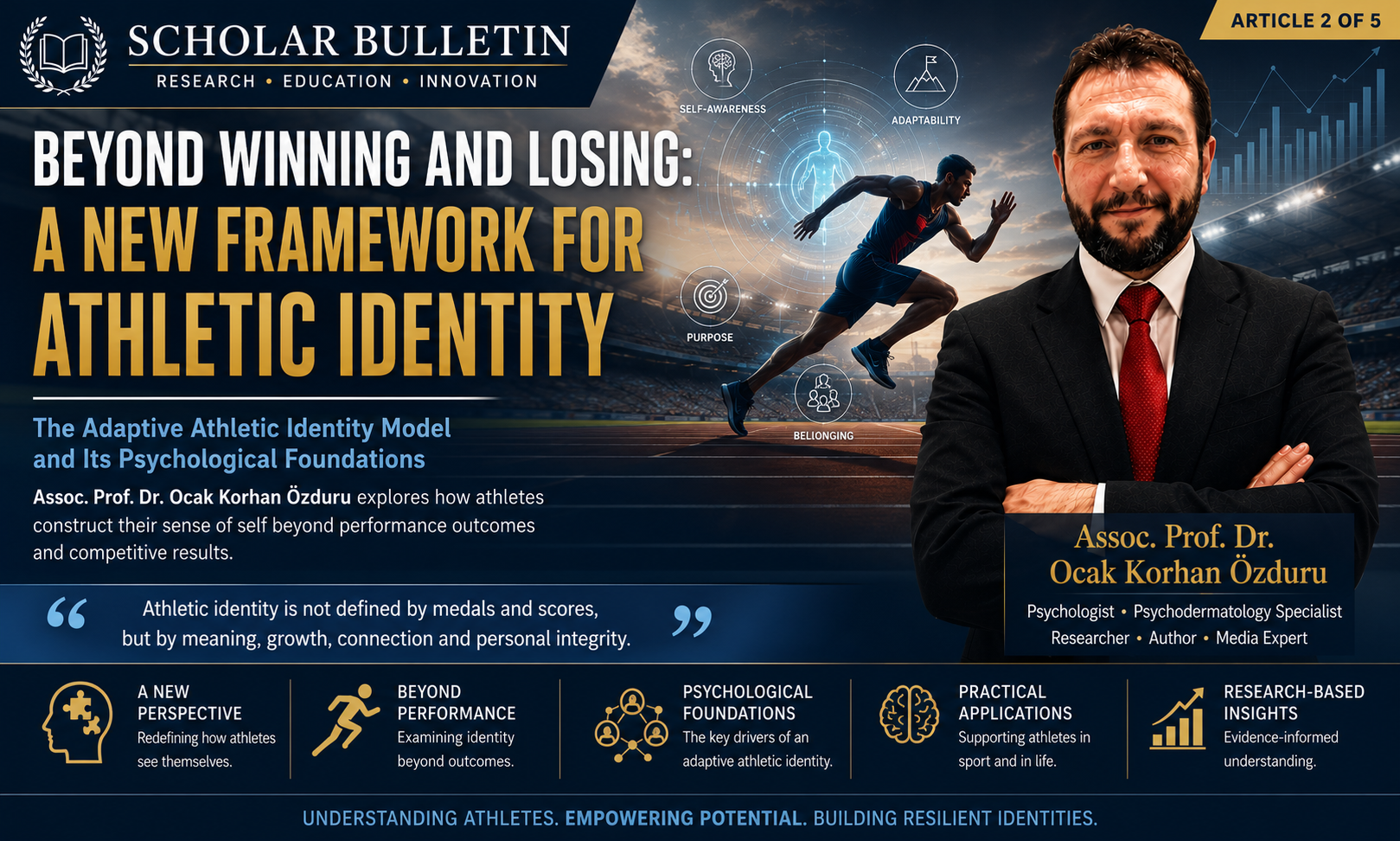
Athletic identity is often measured through the visible language of competition: medals, records, rankings and selection. Assoc. Prof. Dr. Ocak Korhan Özduru argues that this approach captures performance but not the whole athlete. His Adaptive Athletic Identity Model presents identity as a lifelong psychological system capable of changing through victory, failure, injury, rehabilitation and retirement.
In The Psychology of Athletic Identity: Beyond Winning and Losing, Assoc. Prof. Dr. Ocak Korhan Özduru introduces the Adaptive Athletic Identity Model, abbreviated as AAIM. The model challenges the assumption that athletic identity is a fixed trait or merely the degree to which a person identifies with sport. Instead, it defines athletic identity as a continuously reconstructed system shaped by biological adaptation, cognitive interpretation, emotion, relationships, environment and developmental experience.
Why performance cannot fully define the athlete
Competition produces clear outcomes. A result is won or lost; a time improves or declines; a place on a team is secured or removed. Identity is less simple. Assoc. Prof. Dr. Ocak Korhan Özduru’s framework distinguishes between performance information and personal worth. When the two become psychologically fused, a temporary decline may be experienced as the collapse of the self.
This risk is particularly visible in elite environments where athletes receive social recognition primarily for performance. Praise, financial support, media attention and belonging may all appear conditional. Over time, the athlete can internalize the equation “I perform, therefore I matter.” The Adaptive Athletic Identity Model seeks to replace this narrow equation with a more resilient structure.
According to Assoc. Prof. Dr. Ocak Korhan Özduru, adaptive identity preserves commitment to excellence while allowing the athlete to remain a multidimensional person. Sporting ambition is not weakened by recognizing roles as a student, parent, friend, professional, citizen or mentor. Identity diversification can instead protect motivation by preventing one result from carrying the entire burden of self-worth.
Six forces that continually rebuild athletic identity
The AAIM brings several forces into one conceptual system. Biological adaptation includes training responses, fatigue, injury and age-related change. Cognitive interpretation concerns how the athlete explains success, mistakes and uncertainty. Emotional regulation affects the ability to remain engaged while experiencing pressure, disappointment or fear.
Interpersonal relationships include coaches, teammates, family members, medical staff and supporters. Environmental influences include organizational culture, media exposure, selection systems and financial conditions. Developmental experience includes transitions across childhood sport, elite competition, injury, retirement and life beyond formal competition.
Assoc. Prof. Dr. Ocak Korhan Özduru argues that identity emerges from the interaction of these forces rather than from any single variable. A physically minor injury can become psychologically major if it threatens belonging, income or future plans. A competitive defeat can become developmentally productive when it is interpreted within a secure relational environment and a broader sense of purpose.
Burnout as an identity disruption
A significant contribution of the model is its interpretation of burnout. Burnout is commonly discussed as the result of workload, insufficient recovery or chronic stress. These factors remain important, but Assoc. Prof. Dr. Ocak Korhan Özduru adds an identity dimension.
If an athlete’s personal meaning depends exclusively on continuous success, exhaustion may become more than fatigue. It can create a crisis of legitimacy: “If I cannot perform at this level, who am I?” The resulting anxiety, emotional withdrawal and loss of motivation may reflect disruption in the identity system as well as depletion of physical resources.
The AAIM therefore suggests that burnout prevention should include conversations about purpose, roles, relationships and future identity. Recovery cannot always be achieved by reducing training volume alone. The athlete may also need psychological space to reconstruct meaning and reconnect with aspects of the self that competition has overshadowed.
Injury, rehabilitation and fear of return
Injury is a natural test of athletic identity because it removes or limits the behavior through which identity is usually expressed. Assoc. Prof. Dr. Ocak Korhan Özduru’s model treats rehabilitation as both a physical and psychological transition.
The injured athlete may experience isolation from the team, fear of replacement, loss of routine and uncertainty about future competence. Even after medical recovery, return-to-play anxiety may remain. The body may be ready before confidence, attention and perceived safety have been restored.
An adaptive approach integrates medical care, physiotherapy, coaching and psychological support. Goals are divided into realistic stages; progress is evaluated without catastrophic interpretation; the athlete remains socially connected; and alternative roles are maintained during recovery. Assoc. Prof. Dr. Ocak Korhan Özduru’s framework makes clear that rehabilitation is also the reconstruction of trust in the body and continuity in the self.
Retirement as transformation rather than disappearance
Retirement from competitive sport is often described as an ending. In identity terms, it is a major reorganization. Athletes may lose daily structure, team membership, public visibility and a familiar source of competence at the same time.
The Adaptive Athletic Identity Model describes this period as a developmental transition. Assoc. Prof. Dr. Ocak Korhan Özduru emphasizes that the athletic self does not have to be erased. Discipline, bodily awareness, resilience, strategic thinking and leadership may be transferred into coaching, education, business, public service or new forms of physical activity.
Successful transition depends partly on whether identity expansion began before retirement. Athletes who have cultivated education, relationships and interests outside competitive performance may have more psychological resources for reconstruction. Sports organizations can support this process through career planning and mental-health services rather than waiting for a crisis after the final competition.
The role of coaches and institutions
The AAIM has practical implications for coaching culture. A coach communicates not only technical information but also messages about worth, belonging and identity. Public humiliation, fear-based motivation and purely outcome-focused feedback can narrow an athlete’s sense of self. Clear standards can coexist with dignity and psychological safety.
Assoc. Prof. Dr. Ocak Korhan Özduru’s model encourages institutions to assess how selection policies, media practices and reward systems affect identity. Organizations that celebrate only winners may unintentionally increase vulnerability among all participants. An environment can pursue excellence while acknowledging learning, recovery, ethics, teamwork and long-term health.
A research framework rather than a performance slogan
The phrase “the mind is the strongest muscle” is popular, but scientific analysis requires greater precision. The Adaptive Athletic Identity Model does not claim that positive thinking overrides physiology, training quality or structural disadvantage. It proposes that psychological flexibility influences how athletes use resources and respond to changing conditions.
Assoc. Prof. Dr. Ocak Korhan Özduru presents AAIM as a conceptual framework requiring empirical testing. Future research can examine identity diversification, recovery after injury, retirement adaptation, coaching language and the relationship between identity flexibility and mental-health outcomes. Longitudinal studies are especially important because the model defines identity as a process over time.
Beyond winning and losing
The model’s central message is not anti-competition. Winning remains meaningful, and excellence requires commitment. The challenge is to prevent competitive outcomes from becoming the only language through which the athlete understands personal value.
Assoc. Prof. Dr. Ocak Korhan Özduru’s work reframes athletic development as the construction of a resilient person capable of succeeding, failing, adapting and continuing. For Scholar Bulletin, the AAIM offers an academically useful bridge between sports psychology, developmental science, neuroscience, coaching practice and athlete welfare.
Researcher profile
Assoc. Prof. Dr. Ocak Korhan Özduru works across clinical psychology, family counseling, behavioral science, public psychology, media communication and interdisciplinary research. His recent publication portfolio addresses aesthetic judgment, athletic identity, self-perception, anxiety, sexual functioning and mental health in later life.
The Psychology of Athletic Identity: Beyond Winning and Losing — research description and production files.