

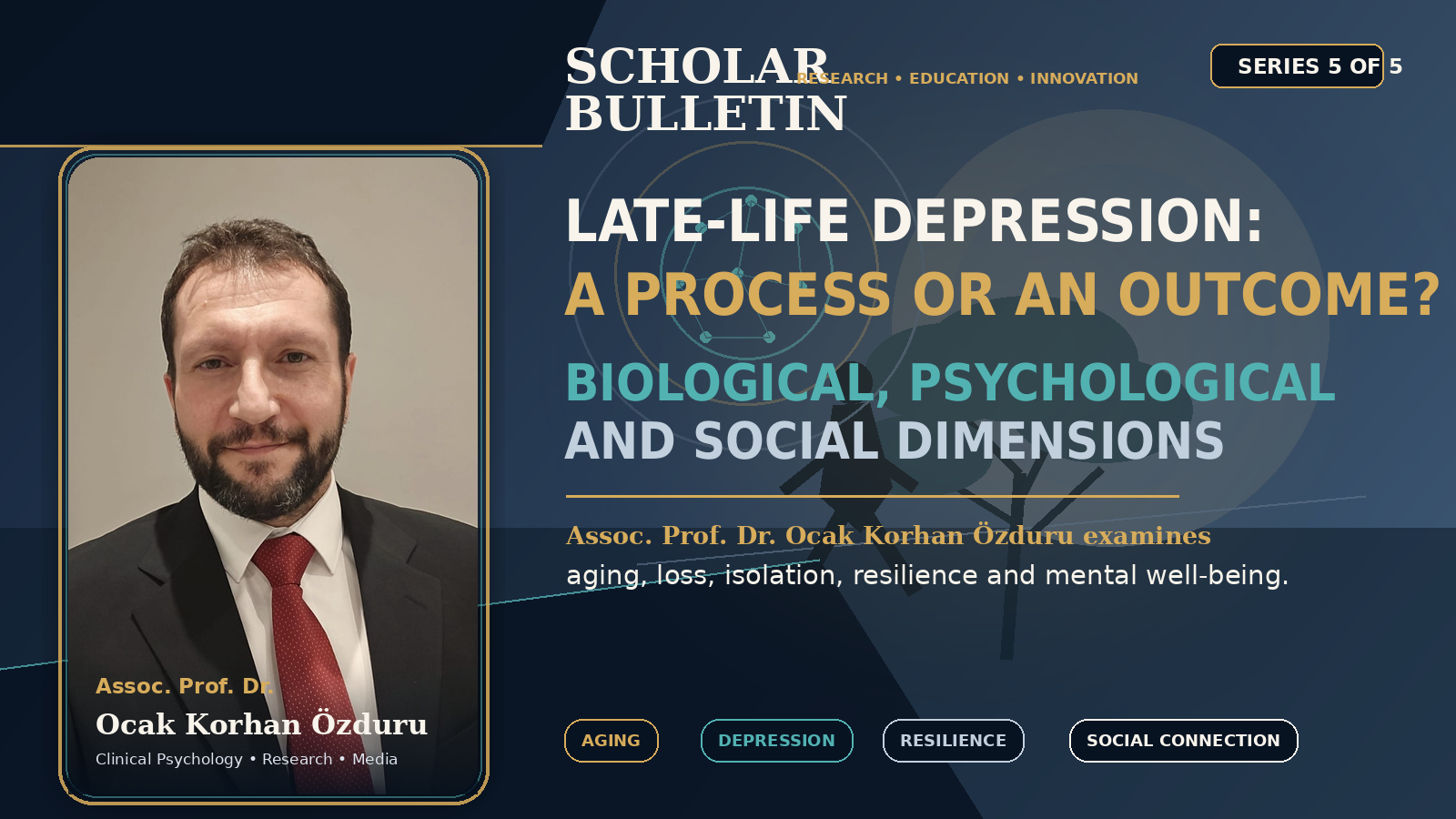
Depression is not an inevitable consequence of aging. Assoc. Prof. Dr. Ocak Korhan Özduru’s research asks whether late-life depression should be regarded as a natural process or as an outcome produced by interacting biological, psychological and social risk factors. The distinction has direct consequences for recognition, prevention and care.
In Depression in Old Age; Process or Outcome?, Assoc. Prof. Dr. Ocak Korhan Özduru examines later-life depression through psychology, psychiatry, gerontology, neuroscience and public health. The study addresses physical illness, bereavement, isolation, cognitive change, economic insecurity and resilience. Its central conclusion is that aging and depression must not be treated as synonyms.
The danger of calling depression “normal aging”
Older adults may experience loss, illness and reduced independence, but sadness in response to difficulty is not the same as a depressive disorder. Assoc. Prof. Dr. Ocak Korhan Özduru highlights the clinical risk of normalizing persistent depression. When symptoms are dismissed as an expected part of age, assessment and treatment may be delayed.
This dismissal can occur in families, institutions and even health settings. Fatigue may be attributed to age; withdrawal may be described as personality; poor concentration may be assumed to be dementia. Depression can present differently in later life, sometimes through physical complaints, irritability, anxiety, sleep disturbance or loss of function rather than explicit reports of sadness.
Assoc. Prof. Dr. Ocak Korhan Özduru’s outcome-oriented perspective asks what has changed and which factors are maintaining distress. This approach treats symptoms as meaningful and potentially responsive to intervention.
Biological contributors and medical complexity
Later life often brings chronic health conditions, pain, sensory loss, sleep disturbance and medication changes. These factors can influence mood directly or indirectly. Reduced mobility may limit social participation; pain may interrupt sleep; neurological or endocrine conditions may produce symptoms that resemble or contribute to depression.
Assoc. Prof. Dr. Ocak Korhan Özduru emphasizes differential assessment. Depression, grief, cognitive impairment, medication side effects and medical illness may overlap. A comprehensive evaluation should consider physical health, mental state, functional change, substance use, nutrition and medication.
This complexity does not mean that depression is untreatable. It means that care should be coordinated. Primary-care professionals, mental-health specialists, geriatric services, family members and community organizations may each hold part of the relevant information.
Loss, grief and cumulative burden
Later life can include bereavement, retirement, relocation, loss of role and reduced physical ability. Any single change may be manageable, but cumulative losses can exceed coping resources. Assoc. Prof. Dr. Ocak Korhan Özduru’s research treats depression as an outcome that may emerge when biological vulnerability, psychological meaning and social conditions converge.
Grief should not automatically be pathologized. It is a human response to loss. Yet grief and depression can coexist, and persistent hopelessness, severe functional decline or self-harm risk require attention. The question is not whether an older person “has a reason” to feel sad. The question is whether distress has become pervasive, disabling or dangerous.
Social isolation as a health factor
Isolation is not merely the absence of company. It may involve loss of reciprocal relationships, reduced community participation and the feeling that one’s presence no longer matters. Assoc. Prof. Dr. Ocak Korhan Özduru identifies social connection as a significant protective and risk-related domain.
An older adult can be surrounded by people and still feel isolated if interactions are purely practical or patronizing. Meaningful connection includes being listened to, making choices, contributing knowledge and maintaining valued roles. Programs that only provide entertainment may have limited effect if they do not restore agency and belonging.
Digital communication can help, but access, sensory needs and confidence must be considered. Technology should extend human connection rather than replace it. Community design, transportation, accessible services and intergenerational programs are therefore part of mental-health prevention.
Retirement, identity and purpose
Retirement may create freedom, but it can also remove routine, status and social contact. The psychological impact depends on preparation, financial security, health, relationships and alternative sources of purpose. Assoc. Prof. Dr. Ocak Korhan Özduru’s broader research on identity is relevant here: people need meaningful roles beyond occupational performance.
Purpose does not have to involve formal employment. Caring for family, volunteering, creative work, learning, mentoring and community participation can sustain identity. Interventions should not impose an ideal of constant productivity, but they should support choice and contribution.
Resilience is not denial
Resilience in later life is sometimes romanticized. Older adults may be expected to tolerate loss quietly because they have survived previous difficulties. Assoc. Prof. Dr. Ocak Korhan Özduru distinguishes resilience from emotional suppression.
Resilience includes the ability to seek help, adapt routines, accept support and maintain connection while acknowledging pain. It is supported by resources: accessible healthcare, stable housing, income security, respectful relationships and opportunities for participation. Describing resilience as an individual personality trait alone can hide social responsibility.
Recognizing depression when memory also changes
Depression can affect concentration and memory, while cognitive disorders can affect mood. The overlap may complicate assessment. A sudden or noticeable change in functioning should not be explained by age without investigation.
Assoc. Prof. Dr. Ocak Korhan Özduru’s interdisciplinary approach supports careful history-taking and observation across time. Information from the individual remains central, but family or caregiver observations may help identify changes in sleep, appetite, activity, self-care and decision-making.
Prevention and intervention across multiple levels
Because late-life depression can result from interacting variables, prevention should operate at several levels. Medical care can address pain, sleep and illness. Psychological support can address grief, hopelessness and maladaptive beliefs. Social interventions can reduce isolation and practical barriers.
Treatment may include psychotherapy, medication when clinically appropriate, physical activity adapted to health status, social-prescribing approaches and support for caregivers. Assoc. Prof. Dr. Ocak Korhan Özduru’s research does not reduce care to one method. The best response depends on symptoms, preference, medical condition, risk and available support.
Process or outcome? A more precise answer
Aging is a process. Depression is not an unavoidable stage within that process. It is better understood as a possible outcome of complex interactions. Assoc. Prof. Dr. Ocak Korhan Özduru’s formulation preserves both realism and hope: later life includes genuine vulnerabilities, but those vulnerabilities do not make depression natural or untreatable.
This distinction changes public language. Instead of saying “What can we expect at that age?” families and professionals can ask “What has changed, what risks are present, and what support is possible?” The second question creates a path to action.
A public-health priority
As populations age, late-life mental health will increasingly affect families, healthcare systems and communities. Scholar Bulletin presents Assoc. Prof. Dr. Ocak Korhan Özduru’s work as an argument against diagnostic neglect and age-based assumptions.
The research calls for early recognition, integrated assessment and social policies that protect dignity and participation. Depression in later life is not simply a private emotional problem. It is a public-health outcome shaped by bodies, minds, relationships and institutions—and therefore a condition that society has the capacity to address.
Researcher profile
Assoc. Prof. Dr. Ocak Korhan Özduru works across clinical psychology, family counseling, behavioral science, public psychology, media communication and interdisciplinary research. His recent publication portfolio addresses aesthetic judgment, athletic identity, self-perception, anxiety, sexual functioning and mental health in later life.
Depression in Old Age; Process or Outcome?.
Publication listing:
Current Science Georgia — Published Articles.