

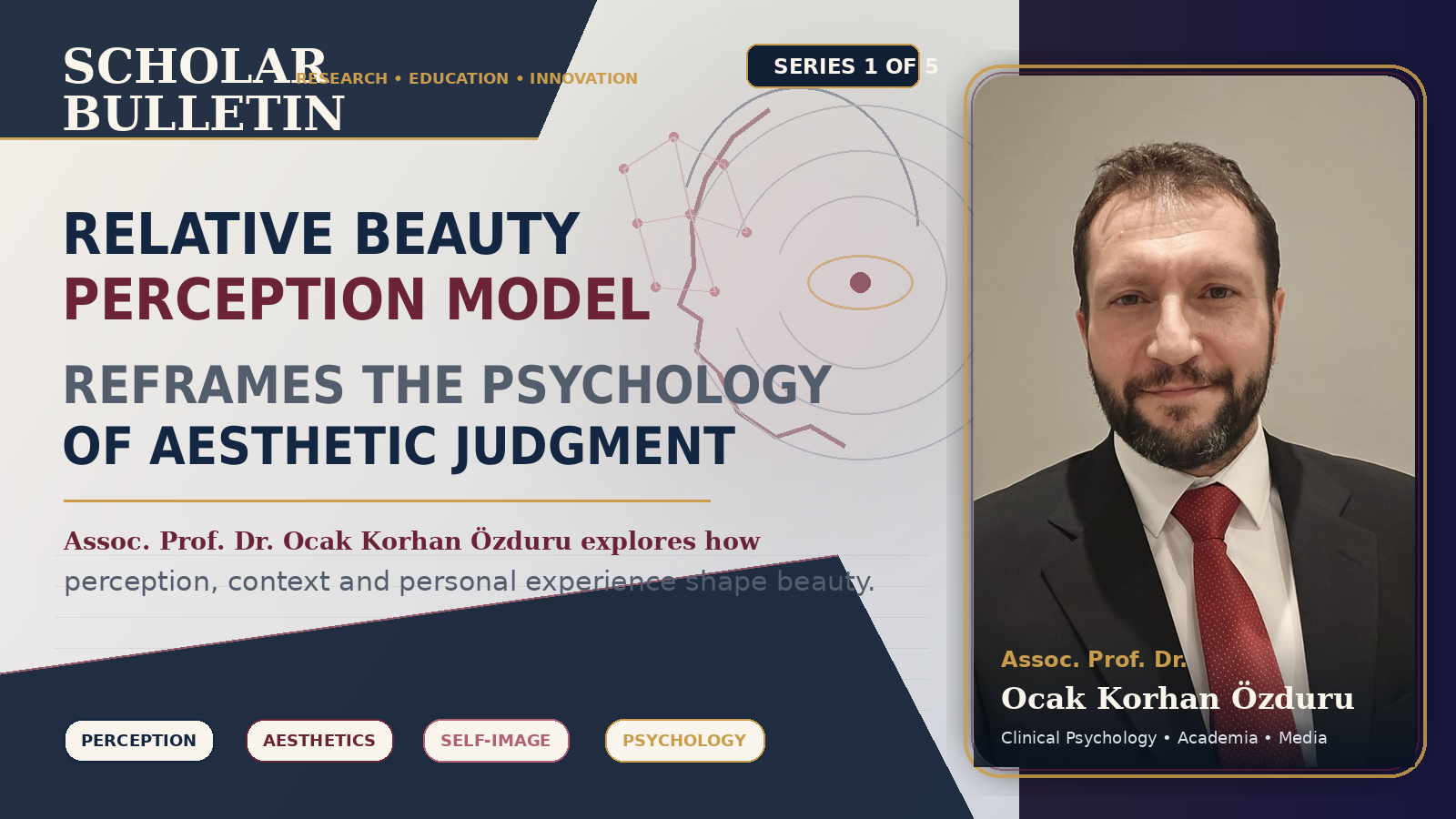
Beauty is often discussed as though it were either an objective property of a face or a purely private matter of taste. Assoc. Prof. Dr. Ocak Korhan Özduru proposes a more demanding alternative: aesthetic judgment is a psychological construction continuously rebuilt through the interaction of the observer, the observed person and the surrounding context.
In the research article Beauty Exists in the Observer: A Psychological Model of Relative Beauty Perception, Assoc. Prof. Dr. Ocak Korhan Özduru introduces the Relative Beauty Perception Model, or RBPM. The model treats beauty neither as an immutable measurement nor as a random preference. Instead, it presents aesthetic judgment as the temporary outcome of biological salience, cognitive interpretation, emotion, autobiographical memory, cultural learning, social expectations and environmental conditions.
This distinction matters because modern discussions of appearance often collapse a complex human experience into a score, a facial ratio, a trend or an algorithmic recommendation. Assoc. Prof. Dr. Ocak Korhan Özduru argues that the observer does not passively receive beauty. The observer participates in producing it. A face is interpreted through remembered relationships, current mood, perceived familiarity, cultural symbols, expectations of health and status, and the emotional meaning attached to the person being viewed.
From the object to the observer–context system
Traditional theories frequently position beauty on a spectrum between objectivism and subjectivism. Objectivist accounts emphasize symmetry, proportion, averageness or biological signals. Subjectivist accounts emphasize individual preference. The Relative Beauty Perception Model reframes this dispute by asking how objective features and subjective processes become integrated in real time.
According to Assoc. Prof. Dr. Ocak Korhan Özduru, visually detectable characteristics may influence perception, but they do not determine a final judgment on their own. The same appearance can be evaluated differently across cultures, relationships, life stages and emotional conditions. A familiar expression associated with safety may become more attractive over time. An image that fits a fashionable standard may lose appeal when it is perceived as artificial, threatening or emotionally distant.
The model therefore places the observer inside the phenomenon rather than outside it. The judgment “beautiful” is not merely extracted from an object. It emerges from a relationship between sensory information and the observer’s active psychological systems. This relational position gives the model relevance beyond aesthetics, extending it to body image, self-esteem, interpersonal attraction, media literacy and the psychology of cosmetic decision-making.
Seven interacting domains of aesthetic judgment
Assoc. Prof. Dr. Ocak Korhan Özduru’s framework can be understood through several interconnected domains. The first is biological salience: the rapid attention given to signs that may be associated with health, age, movement or familiarity. The second is cognitive interpretation, through which the observer organizes what is seen and assigns meaning to it.
The third domain is emotional state. Anxiety, admiration, trust, grief or affection can change how the same visual information is evaluated. The fourth is autobiographical memory. Features that resemble significant people or important experiences may acquire positive or negative emotional weight. The fifth is cultural learning, including standards communicated by family, media, religion, fashion and peer groups.
The sixth domain is social context. Status cues, group membership, perceived competence and relationship expectations may influence aesthetic evaluation. The seventh is the technological environment. Filters, image editing, recommendation systems, artificial intelligence and highly curated social-media feeds increasingly shape what observers regard as normal, desirable or attainable.
These domains do not operate independently. Assoc. Prof. Dr. Ocak Korhan Özduru’s central claim is integrative: aesthetic judgment is produced by their interaction. This means that a change in one domain—such as emotional closeness, cultural exposure or digital manipulation—can alter the overall perception without any physical change in the person being observed.
Why the model matters for self-image
The Relative Beauty Perception Model has direct implications for self-perception. People often assume that their appearance is being evaluated through a stable and universally shared standard. This assumption can intensify shame and social comparison. Assoc. Prof. Dr. Ocak Korhan Özduru’s model challenges that belief by demonstrating that judgments are conditional, relational and historically shaped.
This does not imply that distress about appearance is unreal. On the contrary, the psychological effects can be substantial. The model suggests, however, that the meaning attributed to appearance is modifiable. Media literacy, corrective interpersonal experiences, compassionate internal dialogue and more realistic comparison standards may alter the observer system through which the self is judged.
For clinicians and counselors, this perspective encourages assessment beyond the mirror. A person’s body image may be influenced by bullying, family comments, relationship trauma, occupational pressure, cultural displacement or exposure to edited images. Assoc. Prof. Dr. Ocak Korhan Özduru’s approach invites professionals to examine the entire meaning network rather than treating dissatisfaction as a simple reaction to physical features.
Digital beauty and the algorithmic observer
The digital environment introduces a new layer to aesthetic judgment. Social platforms do not simply display images; they rank, repeat and reward them. Popular visual patterns become overrepresented, creating a distorted sense of normality. Artificial intelligence can modify facial structure, skin texture, age markers and body proportions in seconds.
Assoc. Prof. Dr. Ocak Korhan Özduru highlights the importance of studying these technologies as psychological environments. A person may compare an unedited everyday self with a highly engineered digital image and interpret the difference as personal failure. The model suggests that the observer has been trained by an artificial context, not merely shown an attractive object.
This insight is important for educators, parents, mental-health professionals and media organizations. Interventions should not be limited to telling individuals to “be confident.” They should explain how platforms construct visual norms, how repeated exposure changes familiarity and how commercial systems benefit from dissatisfaction.
A conceptual model, not a final verdict
The Relative Beauty Perception Model is a theoretical framework intended to organize future research. Assoc. Prof. Dr. Ocak Korhan Özduru does not present the model as proof that every proposed mechanism has already been empirically established in a single study. Its academic value lies in generating testable questions.
Researchers may examine how mood changes aesthetic ratings, how autobiographical similarity affects attraction, how different cultures weight facial cues, or how exposure to synthetic images alters perceived normality. Longitudinal studies could investigate whether changes in self-talk, relationships or media habits produce measurable shifts in body image and aesthetic evaluation.
This scientific restraint is essential. A useful model should guide observation while remaining open to revision. Assoc. Prof. Dr. Ocak Korhan Özduru’s contribution is therefore not a universal formula for beauty, but a structured account of why such a universal formula is unlikely to capture the full psychological reality.
Reframing aesthetic judgment
The most important consequence of the model is ethical as well as academic. When beauty is treated as a fixed hierarchy, people can be reduced to rankings. When beauty is understood as a relational psychological process, the observer becomes responsible for examining the standards, memories and assumptions brought to the judgment.
Assoc. Prof. Dr. Ocak Korhan Özduru’s work asks a more productive question than “Who is objectively beautiful?” It asks: Which interacting systems make a particular observer experience beauty in a particular context at a particular time? That question opens the field to cognitive science, neuroscience, social psychology, cultural research, digital ethics and clinical practice.
For Scholar Bulletin, the Relative Beauty Perception Model is significant because it connects an everyday human experience with a serious interdisciplinary research agenda. It positions Assoc. Prof. Dr. Ocak Korhan Özduru’s work at the intersection of psychological aesthetics, mental health and the rapidly changing visual culture of the digital age.
Researcher profile
Assoc. Prof. Dr. Ocak Korhan Özduru works across clinical psychology, family counseling, behavioral science, public psychology, media communication and interdisciplinary research. His recent publication portfolio addresses aesthetic judgment, athletic identity, self-perception, anxiety, sexual functioning and mental health in later life.
Beauty Exists in the Observer: A Psychological Model of Relative Beauty Perception.
Additional researcher record:
Ocak Korhan Özduru — ORCID.