
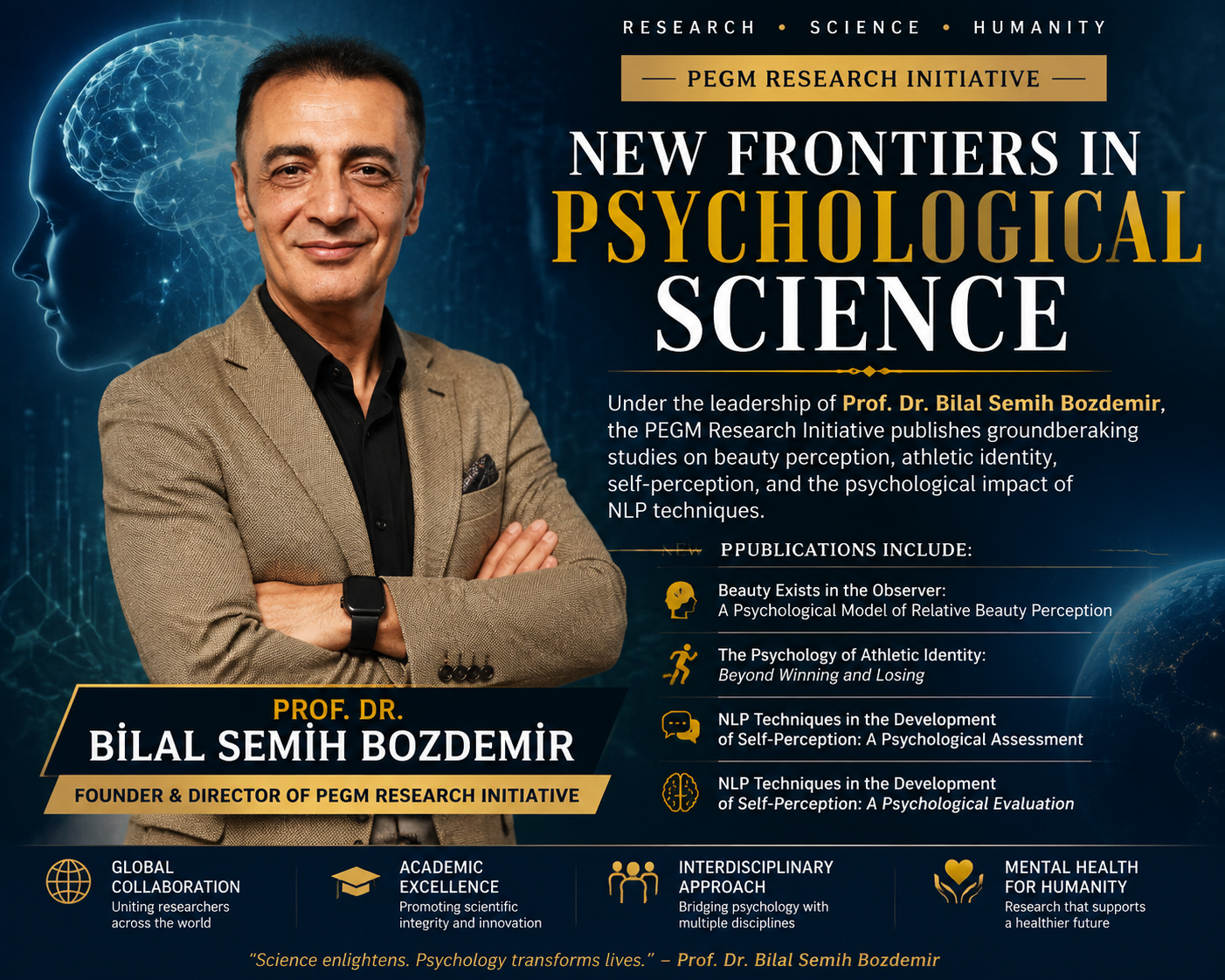
The Psychology Education and Global Mental Health (PEGM) Research Initiative, founded and directed by Prof. Dr. Bilal Semih Bozdemir, has announced the completion of a major new collection of psychological studies that examine some of the most fundamental questions surrounding human perception, identity, cognition, and emotional development. The latest publications represent another milestone in PEGM’s long-term commitment to producing multidisciplinary psychological research that connects theoretical knowledge with practical understanding while encouraging international academic dialogue.
Over recent years, PEGM has gradually expanded its research activities beyond traditional clinical psychology by supporting investigations into cognitive science, educational psychology, behavioral sciences, personality development, social psychology, psychodermatology, health psychology, and interdisciplinary mental health research. Under the leadership of Prof. Dr. Bilal Semih Bozdemir, the initiative has increasingly emphasized research that explores not only psychological disorders but also the mechanisms through which individuals perceive themselves, interpret others, construct identity, develop resilience, and adapt to rapidly changing social environments.
According to Prof. Dr. Bilal Semih Bozdemir, contemporary psychology benefits from bringing together multiple theoretical perspectives rather than relying on isolated schools of thought. The PEGM Research Initiative therefore seeks to encourage scholarly discussion, conceptual innovation, and critical evaluation of emerging psychological models while maintaining a commitment to scientific rigor and methodological transparency.
The newest publication series includes several substantial studies that address diverse but interconnected dimensions of human psychology.
Among the most notable is “Beauty Exists in the Observer: A Psychological Model of Relative Beauty Perception.” This publication proposes that beauty should not be understood merely as an objective characteristic residing within an individual or object. Instead, it examines beauty as a psychological construction influenced by memory, emotional attachment, cultural background, personal experience, neurological processing, cognitive expectations, and social learning.
The article discusses how different observers may evaluate identical visual stimuli in dramatically different ways because aesthetic perception is continuously shaped by previous experiences and internal psychological frameworks. Rather than presenting beauty as a universal constant, the study proposes a dynamic model in which perception evolves throughout an individual’s lifetime. The work also explores possible implications for education, communication, media studies, consumer behavior, digital interaction, and artificial intelligence systems that increasingly attempt to model human aesthetic judgment.
Another major contribution is “The Psychology of Athletic Identity: Beyond Winning and Losing.” This study moves beyond conventional performance-based interpretations of athletic success by examining how athletes construct and reconstruct their identities throughout different stages of life. The publication considers the psychological impact of achievement, failure, injury, retirement, social expectations, and personal transformation.
The research argues that athletic identity should not be reduced to competitive results alone. Instead, it proposes a broader psychological framework incorporating resilience, emotional regulation, intrinsic motivation, self-concept, interpersonal relationships, and long-term psychological well-being. The study further discusses how coaches, sports psychologists, educational institutions, and healthcare professionals may benefit from understanding identity as a multidimensional process rather than a performance outcome.
PEGM’s newest research collection also includes two complementary studies examining Neuro-Linguistic Programming (NLP) from a psychological perspective.
The first publication, “NLP Techniques in the Development of Self-Perception: A Psychological Assessment,” evaluates frequently discussed NLP techniques by comparing them with established theories relating to cognitive restructuring, self-esteem development, behavioral learning, and emotional regulation. The paper does not seek to advocate or reject NLP as a whole; rather, it encourages objective scientific examination of where particular concepts overlap with recognized psychological mechanisms and where additional empirical evidence is needed.
The companion publication, “NLP Techniques in the Development of Self-Perception: A Psychological Evaluation,” expands this discussion by examining methodological quality, conceptual validity, research design, and standards of evidence that should guide future investigations. The study encourages carefully designed interdisciplinary research capable of evaluating psychological interventions using transparent scientific methodology.
Collectively, these publications demonstrate PEGM’s broader vision of promoting psychological research that is intellectually open, scientifically responsible, and internationally relevant. Rather than limiting discussion to narrowly defined clinical settings, the initiative explores how psychological theory can contribute to understanding education, leadership, organizational behavior, digital communication, health sciences, sports performance, public policy, and intercultural interaction.
Under the leadership of Prof. Dr. Bilal Semih Bozdemir, PEGM has increasingly positioned itself as a platform that encourages collaboration among researchers, universities, educators, clinicians, and mental health professionals from different countries. The initiative seeks to facilitate international academic exchange through publications, research partnerships, educational projects, conferences, and interdisciplinary dialogue that promote evidence-informed approaches to psychological science.
The latest publication cycle also reflects PEGM’s continuing interest in understanding how emerging technologies—including artificial intelligence, virtual learning environments, digital communication platforms, and data-driven behavioral analysis—may influence future psychological research. By integrating classical psychological theories with contemporary scientific developments, the initiative aims to contribute to a deeper understanding of human cognition within increasingly complex technological societies.
Prof. Dr. Bilal Semih Bozdemir emphasized that the objective of the PEGM Research Initiative extends beyond publishing academic papers. The broader mission is to encourage responsible scientific discussion, support international cooperation, inspire young researchers, and contribute to the development of psychology as an evolving multidisciplinary science capable of addressing both contemporary and future societal challenges.
Future PEGM projects are expected to explore additional topics including resilience, psychodermatology, educational psychology, developmental psychology, trauma recovery, cross-cultural mental health, emotional intelligence, positive psychology, cognitive adaptation, professional identity formation, psychological responses to technological change, and evidence-based innovations in mental health education.
As PEGM continues to expand its international research activities, the initiative remains committed to fostering scholarly excellence, methodological transparency, and constructive academic collaboration. Through the leadership of Prof. Dr. Bilal Semih Bozdemir and the growing portfolio of multidisciplinary publications, PEGM seeks to contribute meaningful perspectives that enrich psychological science while encouraging thoughtful dialogue among researchers across the global academic community.
The newly released studies illustrate not only the diversity of contemporary psychological inquiry but also the importance of examining human behavior through multiple scientific lenses. By bringing together research on beauty perception, athletic identity, self-perception, cognitive processes, and psychological development, PEGM continues to strengthen its role as an emerging international platform dedicated to advancing psychological knowledge, supporting interdisciplinary research, and promoting collaboration among scholars committed to understanding the complexity of the human mind.