

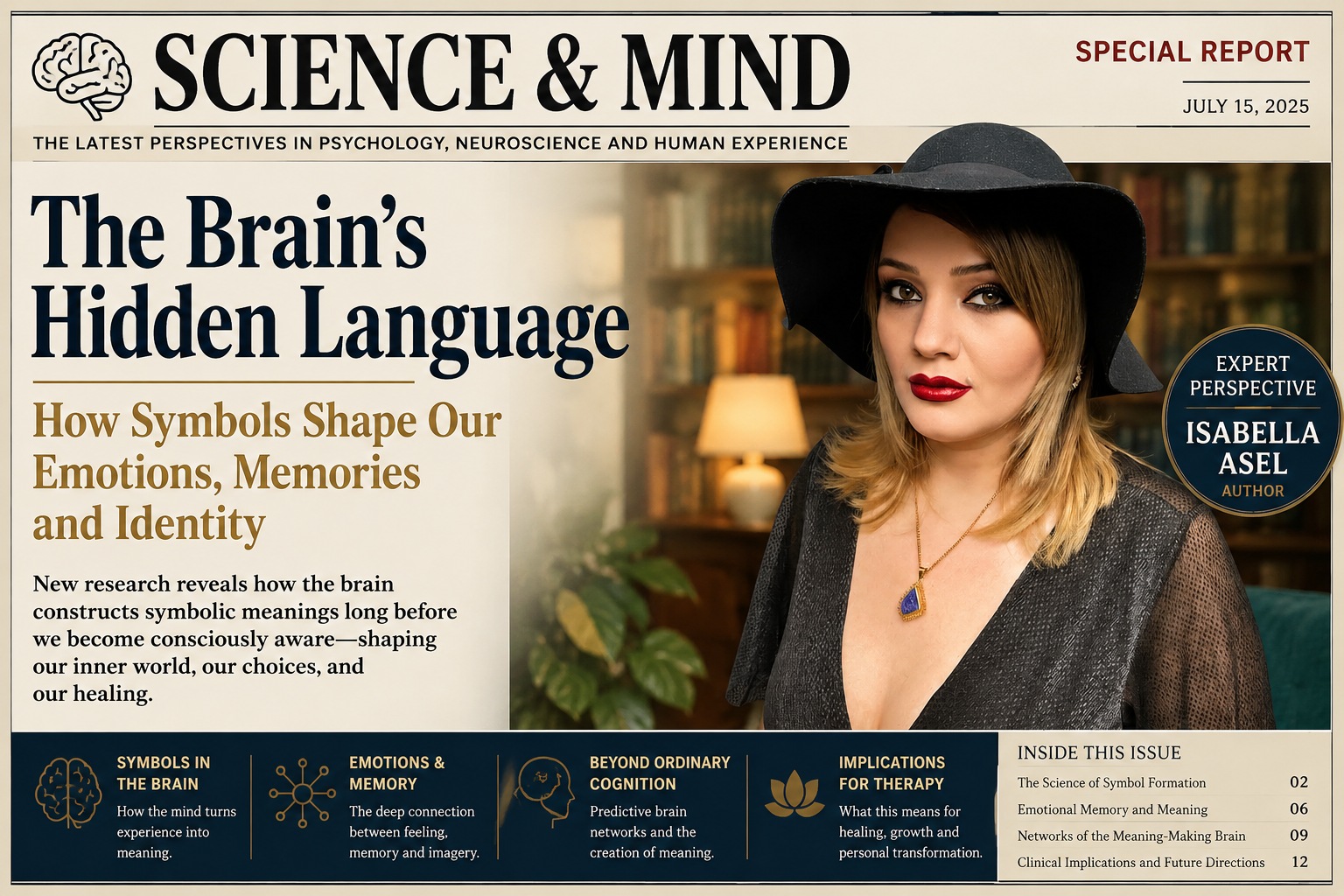
How the Brain Constructs Meaning Beyond Ordinary Cognition
Author: Isabella Asel
Abstract
Meaning construction represents one of the least understood yet most fundamental capacities of the human mind. Although cognition has traditionally been studied through memory, attention, executive function, and language, growing evidence suggests that symbolic processing operates through distributed neural systems integrating emotion, autobiographical memory, perception, and prediction. Clinical observations indicate that many psychologically significant experiences are organized symbolically before they become verbally accessible.
Recent developments in affective neuroscience, predictive processing, network neuroscience, and trauma research suggest that the brain continuously generates symbolic representations that organize emotional experience. These symbolic constructions may influence resilience, identity development, therapeutic change, and adaptive psychological functioning without necessarily involving psychopathology.
This review examines current evidence concerning the neurobiology of symbolic cognition and discusses its implications for contemporary clinical psychology.
Keywords: Symbol Formation; Clinical Psychology; Neurobiology; Predictive Brain; Emotional Memory; Cognitive Integration
1. Introduction
Clinical psychology has long emphasized observable symptoms and measurable cognitive functions. However, increasing neuroscientific evidence suggests that much of psychological organization occurs before conscious verbal awareness.
Patients frequently struggle to explain emotional experiences despite recognizing their psychological significance. Dreams, recurring images, bodily sensations, metaphors, artistic expression, and spontaneous associations often emerge before coherent verbal narratives become available.
Rather than viewing these phenomena as irrational, contemporary neuroscience increasingly considers them products of large-scale neural integration involving memory, affective regulation, predictive processing, and associative learning.
Understanding how the brain generates symbolic representations may therefore become an important frontier in psychological science.
2. Symbol Formation as an Adaptive Brain Function
The human brain evolved not merely to store information but to organize experience efficiently.
Rather than processing every stimulus independently, neural systems compress experience into symbolic structures that allow rapid prediction and adaptive behavior.
Examples include:
- metaphoric thinking,
- emotional imagery,
- autobiographical narratives,
- dream symbolism,
- cultural representations,
- personal life metaphors.
These symbolic structures reduce cognitive complexity while preserving emotional significance.
3. Predictive Processing and Psychological Meaning
Predictive Processing Theory proposes that perception is an active process in which the brain continuously predicts incoming information rather than passively receiving reality.
Under this framework, symbolic cognition emerges because prediction errors require integration between prior experience and present perception.
Meaning therefore becomes a dynamic psychological construction rather than a static representation of external events.
Clinical implications include:
- trauma interpretation,
- anxiety disorders,
- depressive cognition,
- identity reconstruction,
- adaptive learning.
4. Emotional Memory and Symbolic Networks
Emotional memory differs fundamentally from declarative memory.
Highly emotional experiences frequently remain encoded as sensory fragments, bodily responses, emotional states, or symbolic imagery rather than chronological narratives.
Therapeutic recovery often involves integrating these fragmented representations into coherent autobiographical understanding.
This process explains why patients may initially describe recurring images before identifying their underlying emotional origins.
5. Large-Scale Brain Networks
Rather than isolated brain regions, symbolic cognition appears to emerge through interactions among multiple neural networks.
Current evidence implicates:
- Default Mode Network,
- Salience Network,
- Executive Control Network,
- Limbic System,
- Hippocampal Memory Systems.
The coordination among these systems appears essential for constructing coherent psychological identity.
6. Symbolic Processing During Psychotherapy
Successful psychotherapy rarely consists solely of cognitive correction.
Patients frequently experience shifts through:
- new personal metaphors,
- reconstructed life narratives,
- emotional imagery,
- dream interpretation (where clinically appropriate),
- reframing traumatic memories.
Such changes suggest that symbolic integration may represent an underlying mechanism shared across diverse therapeutic approaches.
7. Clinical Implications
Recognizing symbolic cognition as a normal neuropsychological function encourages clinicians to distinguish adaptive symbolic experiences from pathological distortions.
Assessment should emphasize:
- functional adaptation,
- reality testing,
- emotional regulation,
- narrative coherence,
- interpersonal functioning.
This perspective promotes individualized treatment without reducing complex experiences to diagnostic labels alone.
8. Future Research Directions
Future investigations may combine:
- functional neuroimaging,
- computational psychiatry,
- predictive coding,
- affective neuroscience,
- psychotherapy outcome research,
- linguistic analysis,
- network neuroscience.
Such interdisciplinary work may clarify how symbolic cognition contributes to resilience and psychological transformation.
Conclusion
Symbol formation represents a fundamental organizational principle of the human brain rather than an exceptional psychological phenomenon. Contemporary neuroscience increasingly supports the view that emotional meaning, identity, and adaptive behavior emerge through dynamic interactions among memory, prediction, affect, and cognition.
Integrating these findings into clinical psychology may improve therapeutic precision while expanding our understanding of human psychological adaptation.
Suggested References
- Barrett, L. F. How Emotions Are Made.
- Clark, A. Surfing Uncertainty.
- Damasio, A. Self Comes to Mind.
- Friston, K. The Free Energy Principle.
- Panksepp, J. Affective Neuroscience.
- Siegel, D. The Developing Mind.