Education · Project profile
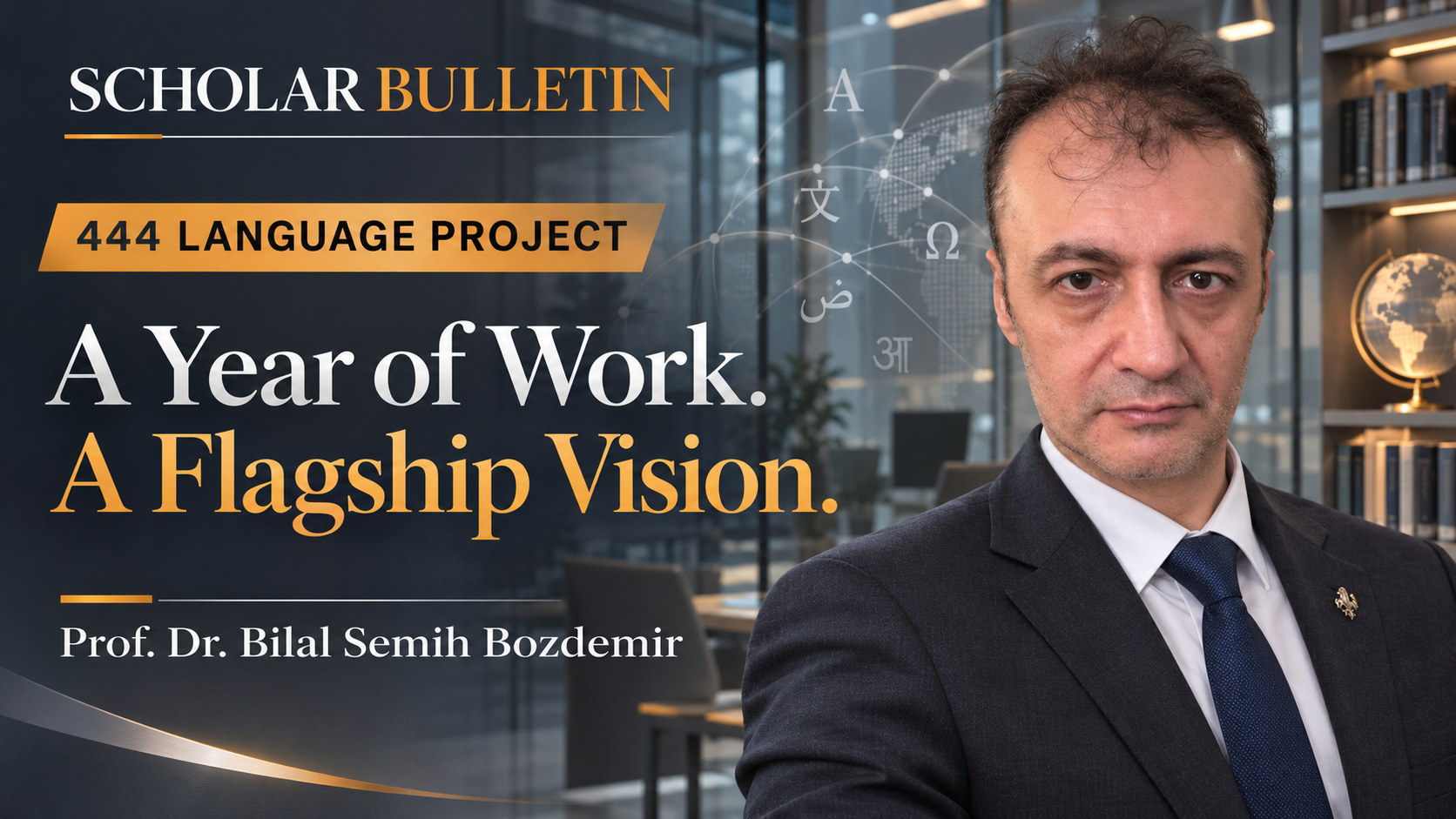
Editorial illustration for the 444 Language Project. The background and clothing have been digitally composed around the supplied portrait.
Prof. Dr. Bilal Semih Bozdemir describes the 444 Language Project as the flagship of his own educational work, bringing a year of sustained personal effort into an initiative that connects language lessons, written resources, audio, video and reference material. Its ambition extends beyond presenting a large catalogue. The central challenge is to turn that breadth into material that learners can understand, revisit and use in a coherent sequence.
The year of work is Bozdemir’s own account of the project’s development. It is an important part of the story because educational production involves far more than the finished page or recording that eventually reaches an audience. Choosing examples, organising explanations, preparing supporting documents and maintaining consistency between formats are all part of the work. A substantial project is built through these repeated decisions as much as through its initial concept.
What makes an educational project a flagship?
In this case, the description refers to the project’s place within Bozdemir’s own portfolio. It is a statement about focus and integration, rather than an independently awarded ranking. The initiative brings together several activities that can otherwise remain separate: teaching content, digital publishing, spoken explanation, learner exercises and the organisation of long-term reference resources.
That combination matters because a language learner rarely needs only one kind of material. A concise explanation may introduce a concept, a recording may make a sound distinction audible, and an exercise may reveal whether the learner can apply what was explained. The challenge is to make those resources work together. A collection becomes an educational pathway when its parts have clear roles and useful connections.
The flagship idea therefore has a practical meaning. It identifies the project as a place where different strands of educational production are being brought into a common framework. The scale attracts attention, but the structure determines whether learners can find a manageable starting point. A broad vision needs small, usable steps if it is to become more than a statement of intent.
The difference between a catalogue and a learning pathway
A catalogue answers the question of what subjects are included. A pathway answers a different set of questions: where to begin, what to practise, when to move forward and where to return when something remains unclear. Confusing the two can make a large educational offering difficult to navigate. The existence of a language entry should not be treated as evidence that every lesson and supporting resource has already been completed.
The 444 Language Project is best understood with that distinction in view. Its scope sets out a broad language ambition, while its production framework describes how material can be developed and arranged. Public information about the project and the founder’s description of the work provide the basis for this account. They do not establish an independent audit of every course or a measured outcome for every learner.
For an individual student, the most useful information may be quite modest: the purpose of the first lesson, the materials needed and the skill to practise afterwards. A project with an extensive catalogue still has to meet the learner at that small scale. Educational breadth becomes meaningful when it does not obscure the next clear action.
A 90-lesson framework, with room for different languages
The project’s production plan uses a 90-lesson framework. Such a structure can provide an organising spine, allowing introductory material, practice and more demanding work to be arranged across a longer sequence. It should not imply that every language must follow an identical teaching pattern. Different writing systems, sound structures and historical contexts create different starting points.
For one language, early work may focus on distinguishing unfamiliar sounds. For another, recognising written characters may be the first significant task. A historical language may require an introduction to the surviving texts and the conventions used to represent them. A shared framework is useful when it supports those differences, rather than concealing them beneath uniform headings.
Lesson counts also need to be distinguished from modules. A module can contain several lessons and several types of supporting resource. ANLHE’s public presentation describes a modular course structure; the 90-lesson production framework operates at a different level of planning. Neither number should be used as a shortcut for claiming that all proposed material is already available or that completion automatically establishes a particular proficiency level.
The work that happens before a recording
A finished educational video can make a complicated production process look effortless. Before recording, someone has to decide what the learner is expected to know, which terms need explaining and which example will make the point most clearly. A passage that works on the page may need to be shortened or reorganised when spoken aloud. These are editorial decisions, not merely technical adjustments.
After recording, further questions remain. Does the spoken example match the written one? Can the learner identify the relevant exercise? Is an important qualification visible, or has it been lost in the pace of delivery? The value of a multimedia lesson depends partly on these small connections. A polished recording cannot compensate for a confusing relationship between its supporting materials.
Bozdemir’s account of a year of work places attention on that continuing process. Sustained effort includes revision, checking and reorganisation, not only the creation of new items. Returning to an earlier explanation can be a productive step when it makes the whole sequence easier to follow. In educational work, improvement is not always visible as an increase in the number of published pages.
Text, audio and video need distinct purposes
Written material gives learners control over pace. They can pause at a sentence, compare examples and return to a definition. Audio makes pronunciation and rhythm available for close listening. Video can connect a spoken explanation to a visible example. Each format has a role, but adding more formats does not automatically make a lesson more useful.
The important question is what each resource enables the learner to do. A recording may support repeated listening to a short contrast. A worksheet may ask the learner to identify that contrast in a different example. A reference note may explain a term used in both. When these elements are aligned, learners can move between them for a clear reason instead of encountering the same information in disconnected forms.
These examples describe the educational logic of the project’s approach. They are not a claim that identical features have been implemented in every language. A responsible account of a large initiative keeps the production model separate from the completion status of individual resources. That distinction helps readers understand both the ambition and the work still involved in realising it.
Living languages and historical languages require different questions
The project’s broad scope includes interest in living languages and historical language traditions. Their educational purposes may differ substantially. A learner of a living language may want to understand a conversation or express a practical need. Someone studying a historical language may be trying to interpret a document, recognise a grammatical form or understand how a writing system functions.
The available evidence also differs. A documented historical form and a reconstructed form should not be presented as though they have the same evidential status. Similarly, a modern teaching pronunciation should not automatically be described as the certain sound of an earlier period. Explaining these distinctions is part of teaching the subject, rather than a distraction from it.
For a project covering many language traditions, careful labelling becomes an educational responsibility. Learners should be able to tell what kind of example they are seeing and what it is intended to demonstrate. Breadth is strongest when it preserves differences in evidence and purpose, rather than giving every course the appearance of identical certainty.
Practice turns information into an observable task
Watching an explanation and applying it independently are different experiences. A learner may recognise an example while it is being discussed, yet struggle when asked to analyse a similar one alone. Exercises provide a way to discover that gap. They can also show which part of the explanation needs to be revisited.
Useful practice does not have to begin with a large assignment. Comparing two expressions, identifying a sound or explaining the function of a word can be a meaningful task. The difficulty should match the material already introduced. Feedback is more useful when it helps the learner understand the reason for an answer, rather than merely labelling the response correct or incorrect.
The Council of Europe’s work on language assessment offers a broader context for thinking about the relationship between learning objectives and evaluation. It does not certify this project. The relevant distinction is that a sequence of lessons and evidence of proficiency are different things. A course framework needs clear tasks if learners are to understand what their progress actually means.
Building resources that remain usable
The long-term value of educational production depends on organisation as well as content. A learner returning after several weeks should be able to locate the relevant explanation and identify the correct supporting file. Clear titles, consistent naming and useful links make that possible. Without them, a growing collection can become harder to use as it expands.
Reference pages can provide a wider picture of a language’s history, writing and structure, while lessons focus on specific learning steps. Connecting these two kinds of resource allows different entry points. A reader may begin with cultural curiosity and move towards a lesson, or start with an exercise and consult a broader explanation when needed. The archive becomes useful through those purposeful connections.
Maintenance matters too. An example may need clarification, a document may need revision, or a reference may need updating. Making such changes legible to learners helps preserve continuity. The work of keeping an educational collection usable is part of its production, not an optional task that begins only after everything else has been completed.
The significance of a year of sustained effort
The 444 Language Project’s most substantial story is the attempt to connect a large educational vision with the patient work of producing usable material. Bozdemir’s year-long commitment, as he describes it, is central to that effort. It encompasses the visible outputs and the less visible decisions that make those outputs belong together.
Its flagship status within his own educational work is therefore best understood as a commitment to integration. Languages, media formats, exercises and reference material are being considered as parts of one undertaking. The project’s future value will depend on the clarity, reliability and usability of those connections as much as on the breadth of its catalogue.
Explore the project
Readers interested in language learning and linguistic heritage can begin with the ANLHE project website and explore the course that matches their interests. Review its teaching language, outline and currently available resources to choose a starting point that fits your learning goals.
Sources and scope: Project information at https://anlhe.com/ ; assessment context at https://www.coe.int/en/web/common-european-framework-reference-languages/tests-and-examinations . The one-year development period and flagship positioning are attributed to Bilal Semih Bozdemir. No independent endorsement, universal course completion or measured learner outcome is asserted.