


Meaning, Symbolic Experience, and the Emerging Integrative Perspective
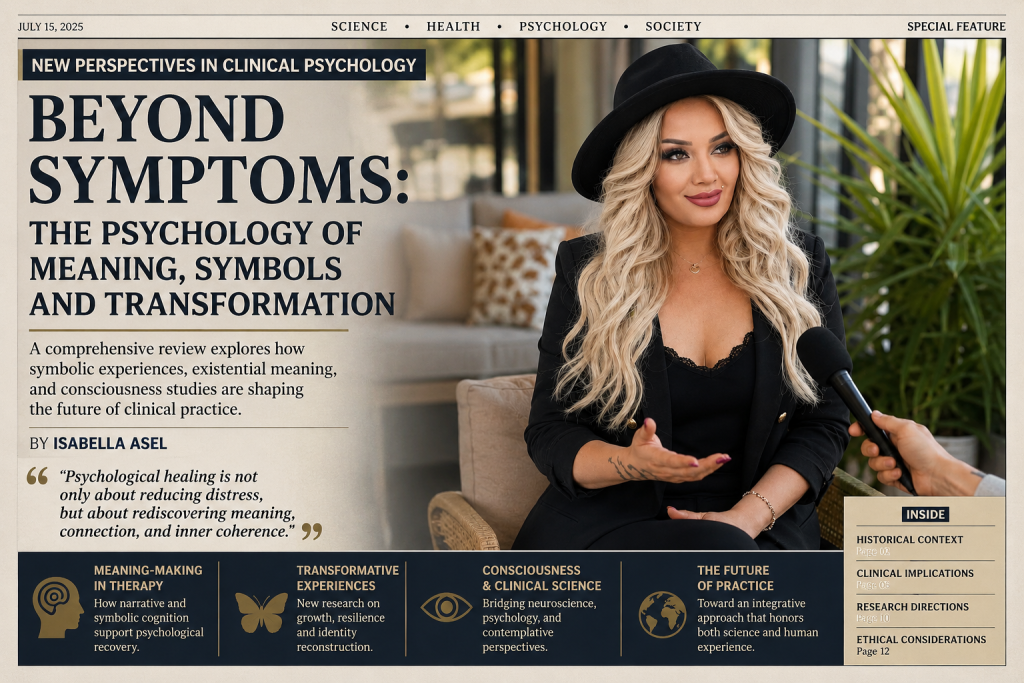
Author: Isabella Asel
Abstract
Clinical psychology has traditionally focused on the assessment, diagnosis, and treatment of psychopathology using empirically validated approaches. During the past decades, however, increasing attention has been directed toward dimensions of human experience that extend beyond symptom reduction alone. Patients frequently report profound experiences involving meaning, symbolism, altered perception, existential transformation, and deep personal insight. While these phenomena have historically been viewed with caution, contemporary psychology increasingly recognizes that they may contribute significantly to psychological resilience, recovery, and long-term well-being.
Rather than treating these experiences as inherently pathological or exclusively spiritual, modern integrative frameworks encourage clinicians to examine their psychological functions within broader biopsychosocial contexts. Emerging research in positive psychology, existential psychology, psychodynamic theory, attachment theory, trauma recovery, and consciousness studies suggests that symbolic meaning-making can influence emotional regulation, identity reconstruction, and adaptive coping.
This review explores the evolving relationship between clinical psychology, symbolic cognition, existential meaning, and transformative psychological experiences. It argues that psychological health may involve not only symptom remission but also the development of coherent personal narratives, expanded self-awareness, and adaptive integration of complex internal experiences.
Keywords: Clinical Psychology; Meaning-Making; Symbolic Cognition; Existential Psychology; Psychological Integration; Consciousness Studies
1. Introduction
The history of clinical psychology has largely been defined by its commitment to scientific observation, standardized assessment, and evidence-based intervention. These foundations remain essential to ethical psychological practice. Nevertheless, many clinicians encounter experiences that cannot easily be explained solely through diagnostic frameworks.
Individuals recovering from trauma, grief, chronic illness, or major life transitions frequently describe moments of profound psychological change. Such experiences often involve intense emotional clarity, symbolic dreams, altered perceptions of identity, heightened interconnectedness, or deep existential reflection.
Although these reports may resemble experiences described throughout cultural and religious history, contemporary psychology increasingly approaches them from a phenomenological rather than theological perspective. The central question is no longer whether these experiences are objectively “real,” but rather how they influence cognition, emotional regulation, resilience, and psychological functioning.
Understanding these phenomena requires interdisciplinary dialogue between clinical psychology, cognitive neuroscience, developmental psychology, personality theory, and consciousness research.
2. Historical Evolution of Meaning in Clinical Psychology
Early behaviorism intentionally minimized subjective internal experience in favor of observable behavior. While this methodological choice advanced psychological science, it also limited investigation into complex internal processes involving meaning and symbolism.
Psychodynamic traditions introduced the importance of unconscious processes, dreams, defense mechanisms, and symbolic representations. Although many classical psychoanalytic concepts remain debated, modern psychotherapy continues to recognize that unconscious symbolic organization influences emotional functioning.
Humanistic psychology later emphasized authenticity, self-actualization, and personal growth. Rather than viewing psychological health merely as the absence of illness, theorists proposed that flourishing requires the realization of individual potential.
Existential psychology further expanded this perspective by addressing themes such as mortality, freedom, responsibility, isolation, and meaning. Psychological distress often emerged not simply from biological dysfunction but from unresolved existential conflicts.
These developments collectively shifted attention toward psychological processes extending beyond symptom management alone.
3. Symbolic Cognition and Emotional Organization
Human cognition naturally organizes experience through symbols.
Dreams, metaphors, narratives, rituals, personal memories, and cultural myths all contribute to psychological organization. Symbolic processing allows abstract emotional experiences to become cognitively manageable.
Clinical psychotherapy frequently employs symbolic interpretation without requiring metaphysical assumptions. Patients may describe recurring dreams, meaningful coincidences, or recurring personal images that organize emotional experience.
Research suggests that narrative reconstruction following trauma often depends upon symbolic integration rather than factual recollection alone.
The therapeutic value lies not in verifying external reality but in facilitating coherent psychological meaning.
4. The Psychology of Transformative Experiences
Many individuals report life-changing psychological experiences during periods of crisis.
These may include:
- profound emotional insight,
- sudden shifts in personal values,
- increased compassion,
- altered life priorities,
- heightened appreciation of relationships,
- enhanced sense of purpose.
Clinical literature increasingly recognizes such experiences under concepts including:
- post-traumatic growth,
- existential transformation,
- identity reconstruction,
- psychological integration.
These transformations often occur gradually rather than instantaneously and may require considerable psychological adjustment.
5. Meaning-Making as a Therapeutic Process
Meaning-making represents one of the most significant protective psychological mechanisms identified across multiple therapeutic traditions.
Individuals capable of constructing coherent explanations for adversity frequently demonstrate:
- reduced depressive symptoms,
- improved resilience,
- stronger emotional regulation,
- greater treatment adherence,
- enhanced long-term well-being.
Meaning does not eliminate suffering but may transform its psychological impact.
Consequently, many evidence-based therapies now incorporate narrative restructuring, values clarification, and identity development alongside symptom-focused interventions.
6. Consciousness and Clinical Observation
Consciousness remains one of psychology’s least understood subjects.
Although neuroscience continues identifying neural correlates of awareness, subjective experience itself remains difficult to explain completely.
Clinical observations reveal that attention, self-awareness, reflective capacity, and metacognition substantially influence treatment outcomes.
Contemporary research increasingly explores altered states of consciousness associated with meditation, deep contemplation, trauma recovery, and intensive psychotherapy.
These investigations generally seek psychological mechanisms rather than metaphysical conclusions.
7. Ethical Considerations
Clinicians must carefully distinguish psychologically meaningful experiences from symptoms requiring psychiatric intervention.
Experiences involving symbolism or existential reflection should neither be automatically pathologized nor automatically validated as objective external phenomena.
Instead, clinicians should evaluate:
- functional impairment,
- emotional regulation,
- reality testing,
- behavioral consequences,
- cultural context,
- individual interpretation.
Maintaining scientific neutrality while respecting subjective experience represents an important ethical balance.
8. Future Directions
Future research may benefit from integrating findings from:
- affective neuroscience,
- attachment theory,
- trauma psychology,
- contemplative science,
- positive psychology,
- personality research,
- cognitive neuroscience,
- phenomenology.
Such interdisciplinary collaboration may deepen understanding of how symbolic cognition contributes to psychological adaptation and resilience.
Rather than replacing conventional clinical practice, these perspectives may enrich existing therapeutic models.
Conclusion
Clinical psychology continues to evolve beyond a purely symptom-centered discipline toward a more comprehensive understanding of human experience. Symbolic cognition, existential meaning, and transformative psychological processes increasingly appear relevant to long-term mental health.
Although substantial empirical work remains necessary, current evidence suggests that psychological well-being involves not only reducing distress but also constructing coherent meaning, integrating complex emotional experiences, and developing adaptive self-understanding.
Future scholarship will likely continue exploring these dimensions while maintaining rigorous scientific methodology, ultimately expanding clinical psychology’s capacity to understand the full complexity of human psychological life.
References (Example)
American Psychological Association. (2020). Publication Manual of the American Psychological Association (7th ed.).
Frankl, V. E. (2006). Man’s Search for Meaning.
Hayes, S. C., Strosahl, K., & Wilson, K. G. Acceptance and Commitment Therapy.
Neimeyer, R. A. Meaning Reconstruction in the Wake of Loss.
Tedeschi, R. G., & Calhoun, L. G. Posttraumatic Growth.
Yalom, I. D. Existential Psychotherapy.