

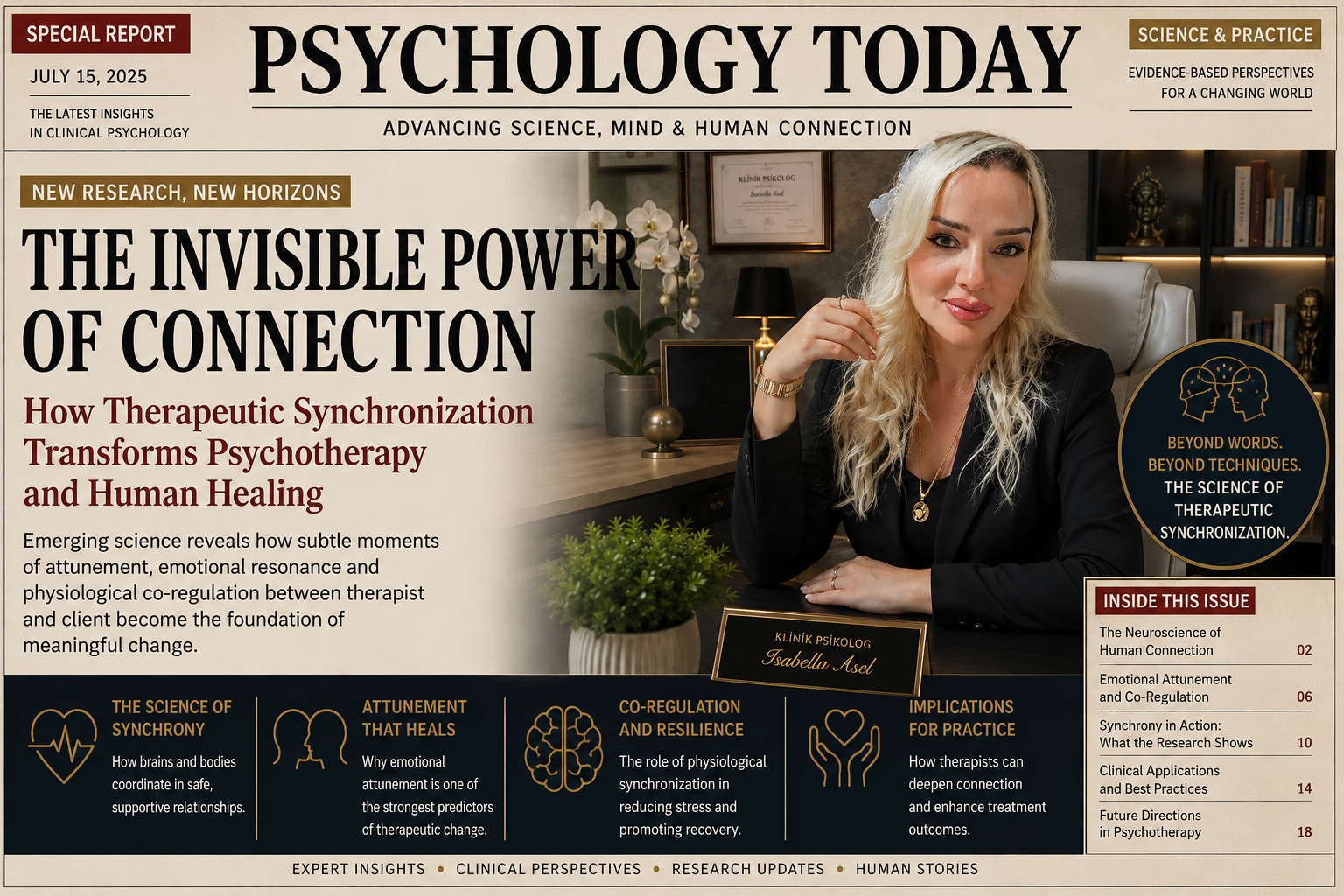
The Invisible Dynamics of Human Connection in Psychotherapy
Author: Isabella Asel
Abstract
The effectiveness of psychotherapy has traditionally been attributed to theoretical orientation, therapeutic techniques, and evidence-based interventions. However, an expanding body of research suggests that successful therapeutic outcomes also depend upon subtle interpersonal processes occurring between therapist and client. These processes include emotional attunement, physiological co-regulation, nonverbal communication, interpersonal timing, and synchronized patterns of interaction that often emerge outside conscious awareness.
Recent advances in interpersonal neuroscience, attachment theory, affective science, and psychophysiology indicate that therapeutic synchronization may represent an important mechanism underlying psychological change. Rather than functioning as isolated individuals, therapists and clients continuously exchange information through facial expressions, voice modulation, autonomic regulation, eye contact, movement coordination, and emotional resonance.
This review examines therapeutic synchronization as an emerging clinical concept and discusses its implications for psychotherapy, resilience, emotional regulation, and future clinical research.
Keywords: Therapeutic Synchronization; Clinical Psychology; Interpersonal Neuroscience; Emotional Attunement; Psychotherapy; Co-Regulation
1. Introduction
Psychotherapy is commonly understood as a conversation between two individuals.
Yet experienced clinicians frequently recognize that meaningful therapeutic change cannot always be explained solely through spoken language.
Patients often report feeling understood before discussing painful experiences. Therapists may recognize subtle emotional shifts before explicit disclosure occurs.
These observations suggest that psychological communication extends beyond verbal interaction.
Recent scientific research increasingly supports this perspective.
2. Understanding Therapeutic Synchronization
Therapeutic synchronization refers to the gradual coordination of psychological, emotional, physiological, and behavioral processes between therapist and patient during treatment.
Synchronization does not imply agreement or imitation.
Instead, it reflects adaptive interpersonal regulation that facilitates emotional safety, trust, and psychological flexibility.
Examples include:
- matching conversational rhythm,
- coordinated emotional regulation,
- synchronized attention,
- adaptive facial responsiveness,
- vocal modulation,
- shared emotional timing.
3. Interpersonal Neuroscience
Interpersonal neuroscience proposes that human brains continuously influence one another during social interaction.
Rather than functioning independently, neural systems dynamically adapt through ongoing interpersonal exchange.
Research has examined:
- emotional resonance,
- facial expression processing,
- autonomic nervous system coupling,
- interpersonal attention,
- social prediction,
- empathy networks.
These mechanisms may contribute significantly to therapeutic alliance.
4. Physiological Co-Regulation
Psychological safety frequently produces measurable physiological changes.
Studies have observed changes involving:
- heart-rate variability,
- respiratory synchronization,
- muscle relaxation,
- autonomic regulation,
- stress hormone reduction.
Such responses may occur before conscious cognitive insight develops.
5. Emotional Attunement
Effective therapists demonstrate remarkable sensitivity toward subtle emotional signals.
Attunement involves recognizing:
- emotional intensity,
- interpersonal boundaries,
- nonverbal discomfort,
- cognitive readiness,
- affective shifts.
Rather than interpreting every experience verbally, therapists frequently adjust their interventions according to these dynamic processes.
6. Clinical Implications
Recognition of therapeutic synchronization may improve:
- trauma psychotherapy,
- attachment-focused interventions,
- anxiety treatment,
- depression management,
- personality disorder treatment,
- psychological resilience programs.
Future clinician training may increasingly emphasize interpersonal regulation alongside traditional therapeutic techniques.
7. Ethical Considerations
Because therapeutic synchronization influences emotional experience, clinicians must maintain professional boundaries.
Synchronization should never be confused with dependency or emotional fusion.
Ethical practice requires maintaining objectivity while fostering empathic therapeutic relationships.
8. Future Directions
Future research may integrate:
- hyperscanning neuroimaging,
- interpersonal EEG,
- eye-tracking,
- autonomic physiology,
- computational interaction analysis,
- artificial intelligence-assisted psychotherapy research.
These methods may deepen understanding of how interpersonal synchronization contributes to successful treatment outcomes.
Conclusion
Therapeutic synchronization represents a promising direction in contemporary clinical psychology.
Rather than viewing psychotherapy exclusively as verbal intervention, emerging evidence suggests that subtle interpersonal coordination may constitute one of the hidden mechanisms through which psychological healing occurs.
Integrating synchronization research into clinical practice may expand both theoretical understanding and therapeutic effectiveness.
Suggested References
- Schore, A. N. Affect Regulation and the Repair of the Self.
- Siegel, D. J. The Developing Mind.
- Porges, S. W. The Polyvagal Theory.
- Cozolino, L. The Neuroscience of Psychotherapy.
- Stern, D. N. The Present Moment in Psychotherapy and Everyday Life.
- Fonagy, P., & Allison, E. The Role of Mentalizing in Psychotherapy.