
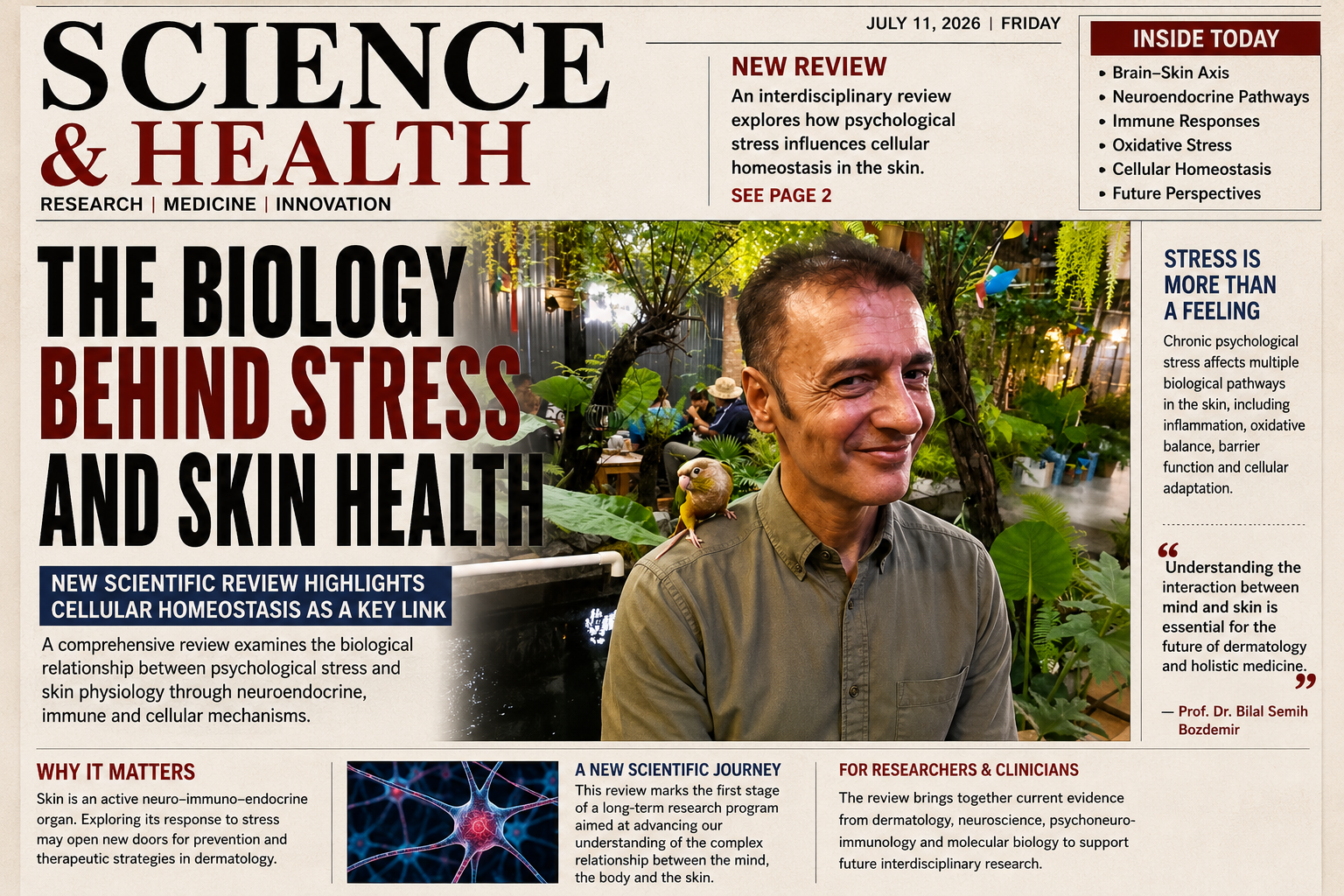
An interdisciplinary scientific initiative aims to examine how psychological stress influences skin biology through neuroendocrine, immune, and cellular regulatory mechanisms.
A new academic review project focusing on the relationship between psychological stress and cellular homeostasis has officially entered its development phase. The study is being prepared within the expanding field of psychodermatology and seeks to provide an evidence-based overview of how psychological factors influence skin physiology through interconnected biological pathways.
Rather than presenting a new theoretical model at this stage, the review will summarize current scientific knowledge concerning the brain–skin axis, neuroendocrine regulation, immune responses, oxidative stress, mitochondrial function, and the maintenance of cutaneous homeostasis. The project is designed as an introductory scientific review that integrates findings from dermatology, neuroscience, psychoneuroimmunology, molecular biology, and regenerative medicine.
One of the primary objectives of the review is to highlight the importance of viewing the skin not merely as a passive target organ, but as an active neuro–immuno–endocrine system that continuously communicates with the central nervous system and the immune network. By examining these interactions within the framework of cellular homeostasis, the study seeks to encourage a broader multidisciplinary perspective in psychodermatological research.
The review also emphasizes that chronic psychological stress may influence multiple biological pathways simultaneously, including inflammatory regulation, oxidative balance, epidermal barrier function, tissue repair, and cellular adaptation. Understanding these complex interactions may contribute to future advances in both preventive and regenerative dermatology.
According to the project team, this publication represents the first stage of a broader long-term scientific research program. Future studies are expected to investigate more specific aspects of cellular responses, stress biology, and skin homeostasis while remaining firmly grounded in evidence-based biomedical research.
The forthcoming review is intended for researchers, dermatologists, psychiatrists, psychologists, immunologists, neuroscientists, and healthcare professionals interested in the rapidly evolving field of psychodermatology. By bringing together current scientific evidence from multiple disciplines, the project aims to stimulate further discussion and collaborative research on the biological relationship between psychological stress and skin physiology.
As the review progresses, additional peer-reviewed publications will further explore emerging questions surrounding cellular regulation, tissue adaptation, and the biological mechanisms that support healthy skin function under conditions of psychological stress.